
A Brief But Spectacular take on questions of belonging
Clip: 1/6/2026 | 3m 23sVideo has Closed Captions
A Brief But Spectacular take on questions of belonging
Tailyr Irvine is a photojournalist from the Flathead Reservation in Montana, whose work focuses on nuanced portrayals of life in Native communities. Her recent project examines the U.S. government–imposed system that defines Native identity through fractional measures of ancestry. She shares her Brief But Spectacular take on questions of belonging.
Problems playing video? | Closed Captioning Feedback
Problems playing video? | Closed Captioning Feedback
Major corporate funding for the PBS News Hour is provided by BDO, BNSF, Consumer Cellular, American Cruise Lines, and Raymond James. Funding for the PBS NewsHour Weekend is provided by...
Support provided by:

A Brief But Spectacular take on questions of belonging
Clip: 1/6/2026 | 3m 23sVideo has Closed Captions
Tailyr Irvine is a photojournalist from the Flathead Reservation in Montana, whose work focuses on nuanced portrayals of life in Native communities. Her recent project examines the U.S. government–imposed system that defines Native identity through fractional measures of ancestry. She shares her Brief But Spectacular take on questions of belonging.
Problems playing video? | Closed Captioning Feedback
How to Watch PBS News Hour
PBS News Hour is available to stream on pbs.org and the free PBS App, available on iPhone, Apple TV, Android TV, Android smartphones, Amazon Fire TV, Amazon Fire Tablet, Roku, Samsung Smart TV, and Vizio.
Providing Support for PBS.org
Learn Moreabout PBS online sponsorshipGEOFF BENNETT: Tailyr Irvine is a photojournalist from the Flathead Reservation in Montana whose work focuses on nuanced portrayals of life in native communities.
Her recent project examines the U.S.
government-imposed system that defines Native identity through fractional measures of ancestry.
Tonight, she shares her Brief But Spectacular take on questions of belonging.
TAILYR IRVINE, Photojournalist: For a long time, I was really hesitant at photographing Natives in regalia.
Seeing those images and seeing only those images really pushed me to tell the other side of the story, not the still life, not the satiric, not sad, not vulnerable, but just powerful communities that are doing great work and have amazing people in them.
I grew up on the Flathead Reservation.
It's in Northwest Montana surrounded by big mountains, a lot of forest, a lot of trees.
Growing up, I didn't think that you could be a photographer.
I didn't think that was like a career that you could actually make money and a living off of.
When I left home for college, I was in a class that was a prerequisite.
It was called Media History and Literacy, and there was a chapter on photography.
And when I'd seen those photos from 9/11, the impact those photos had on me decades later and how I felt when I had seen them really inspired me and made me want to do that too and tell stories from my home that reach people in the same way, the power of photography to connect people and to make us realize we're more alike than different.
One of my goals is just to photograph Natives being people.
I'm part of a community, part of a larger world.
And so showing the other side of what Native America looks like from somebody who's from Native America was really important to me.
My project Reservation Mathematics: Navigating Love in Native America focuses on how the government-imposed system of blood quantum affects who Natives marry, who they have kids with, who they choose to fall in love with, who they choose to spend their life with and how this number dictates one of the most intimate choices that we have.
Every Native, when they're born, they're assigned a fraction at birth.
And that fraction is called blood quantum.
It's how much Native they are.
And each tribe has an amount that you have to be to be involved in that tribe.
For my tribe, it's a quarter.
But it's tricky, because my parents are two tribes.
My mom is Crow.
My dad is Salish and Kootenai.
And so, when I was born, they had to pick which tribe to put me in.
They chose my father's tribe.
And that immediately cut my quantum in half.
And so I'm 7/16s, which means, if I want my kid to be enrolled, they have to be a quarter.
So I need to find someone from my tribe to date.
Otherwise, my kid won't be enrolled.
And so it's just kind of a unique pressure where, if I don't find someone to date within my tribe, then my tribe will -- then I'll probably be partly responsible for my tribe going extinct.
When I started this project, it was really hard because blood quantum is not a real number.
It's not a real thing that exists.
And so how do I photograph something imaginary was something that was really challenging for me?
I got really lucky, because my siblings were all expecting at the same time, my brother with a partner who's not from our tribe, my sister with a partner who's from our tribe, and my other sister with the partner who's from my tribe.
When people look at the photos, I want them to feel connected to the person.
I want them to think, oh, that could be me, that could be my sister, my brother.
Putting people in other people's shoes is kind of why I got into this and why I love photography.
I think you don't have to even speak the same language to understand what's going on in a photo.
And so I hope people are able to kind of put themselves into my culture for a second or two.
My name is Tailyr Irvine, and this is my Brief But Spectacular take on photographing blood quantum.
GEOFF BENNETT: You can watch more Brief But Spectacular videos online at PBS.org/NewsHour/Brief.
European leaders reject Trump's demands for Greenland
Video has Closed Captions
Clip: 1/6/2026 | 4m 54s | After Trump's removal of Maduro, European leaders reject his demands for Greenland (4m 54s)
Fight over how Jan. 6 is remembered continues 5 years later
Video has Closed Captions
Clip: 1/6/2026 | 9m 12s | 5 years later, the fight over how Jan. 6 is remembered continues (9m 12s)
How the aftermath of Jan. 6 still challenges the Capitol
Video has Closed Captions
Clip: 1/6/2026 | 4m 17s | How the aftermath of Jan. 6 still challenges the Capitol (4m 17s)
Latin America analyst, ex-ambassador split on Trump Doctrine
Video has Closed Captions
Clip: 1/6/2026 | 10m 43s | Latin America analyst, ex-ambassador offer views on 'Trump Doctrine' (10m 43s)
Pardoned Jan. 6 rioters return to Capitol on 5th anniversary
Video has Closed Captions
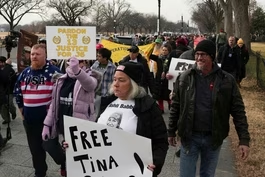
Clip: 1/6/2026 | 6m 11s | Pardoned Jan. 6 rioters return to Capitol on 5th anniversary of insurrection (6m 11s)

Trump's push to access Venezuela's oil faces major barriers
Video has Closed Captions
Clip: 1/6/2026 | 7m 44s | Trump's push to access Venezuela's oil reserves faces major barriers (7m 44s)
Providing Support for PBS.org
Learn Moreabout PBS online sponsorship
- News and Public Affairs

FRONTLINE is investigative journalism that questions, explains and changes our world.

- News and Public Affairs

Amanpour and Company features conversations with leaders and decision makers.












Support for PBS provided by:
Major corporate funding for the PBS News Hour is provided by BDO, BNSF, Consumer Cellular, American Cruise Lines, and Raymond James. Funding for the PBS NewsHour Weekend is provided by...