
December 15, 2025 - PBS News Hour full episode
12/15/2025 | 57m 46sVideo has Closed Captions
December 15, 2025 - PBS News Hour full episode
Monday on the News Hour, authorities renew their search for the Brown University shooter and Australian leaders vow to toughen gun laws after an attack at a Hanukkah festival. Hong Kong democracy activist Jimmy Lai is convicted in a case that's become a symbol of Beijing’s crackdown on dissent. Plus, how Trump's immigration crackdown is affecting people who spent years trying to become citizens.
Problems playing video? | Closed Captioning Feedback
Problems playing video? | Closed Captioning Feedback
Major corporate funding for the PBS News Hour is provided by BDO, BNSF, Consumer Cellular, American Cruise Lines, and Raymond James. Funding for the PBS NewsHour Weekend is provided by...
December 15, 2025 - PBS News Hour full episode
12/15/2025 | 57m 46sVideo has Closed Captions
Monday on the News Hour, authorities renew their search for the Brown University shooter and Australian leaders vow to toughen gun laws after an attack at a Hanukkah festival. Hong Kong democracy activist Jimmy Lai is convicted in a case that's become a symbol of Beijing’s crackdown on dissent. Plus, how Trump's immigration crackdown is affecting people who spent years trying to become citizens.
Problems playing video? | Closed Captioning Feedback
How to Watch PBS News Hour
PBS News Hour is available to stream on pbs.org and the free PBS App, available on iPhone, Apple TV, Android TV, Android smartphones, Amazon Fire TV, Amazon Fire Tablet, Roku, Samsung Smart TV, and Vizio.
Providing Support for PBS.org
Learn Moreabout PBS online sponsorshipAMNA NAWAZ: Good evening.
I'm Amna Nawaz.
GEOFF BENNETT: And I'm Geoff Bennett.
On the "News Hour" tonight: the fallout from two mass shootings.
Authorities renew their search for the Brown University shooter, and Australian leaders vow to toughen gun laws after an attack at a Hanukkah festival.
AMNA NAWAZ: Former pro-democracy activist and media mogul Jimmy Lai is convicted in Hong Kong, in a case that's become a symbol of Beijing's crackdown on dissent.
GEOFF BENNETT: And how the Trump administration's immigration policy is affecting people who have spent years trying to become U.S.
citizens.
GAIL BRESLOW, Executive Director, Project Citizenship: This is a thinly veiled attempt to thwart people's efforts to become citizens of this country.
(BREAK) GEOFF BENNETT: Welcome to the "News Hour."
The fallout from two weekend mass shootings continued today, one in Rhode Island, the other half-a-world away in Australia.
AMNA NAWAZ: We begin in Providence, Rhode Island, where officials today released new video of a person of interest as the hunt continues for the gunman behind a shooting in a lecture hall at Brown University.
Two students were killed and nine others were injured.
A short time ago, officials said they're still searching for the suspect and for more leads.
TED DOCKS, FBI Special Agent in Charge: We are renewing our call for the public's assistance in seeking any and all information about the shooter.
No amount of information is too small or irrelevant.
We are also here to announce the FBI is now offering a reward of $50,000 for information that can lead to the identification, the arrest and the conviction of the individual responsible, who we believe to be armed and dangerous.
AMNA NAWAZ: Earlier in the day, most students left campus after classes and exams were canceled, but an increased police presence remained in the area and the community is coping with the aftermath.
(SINGING) AMNA NAWAZ: Huddled together in the frigid night air, the Brown University community gathered in grief last night.
What was once planned as a Christmas tree and menorah lighting celebration was now a moment to mourn.
ANAND ADVANI, Brown University Student: We're all very sad and coming out of a period of being very scared.
AMNA NAWAZ: Ph.D.
Student Jaren Friesen recalled the shooting.
JAREN FRIESEN, Brown University Student: I had heard some loud sound.
I am so conditioned to thinking that something like that could happen.
So my first instinct was that it was a gun.
AMNA NAWAZ: An all-too-common event for American students, this time claiming the lives of two, identified by authorities as Muhammad Aziz Umurzakov and Ella Cook; 18-year-old Umurzakov, a freshman from Midlothian, Virginia, was described by the American Uzbekistan Association as sharp, kind-hearted and gifted and, according to his family, dreamed of becoming a neurosurgeon.
Ella Cook was just 19 years old, a sophomore from Mountain Brook, Alabama, an accomplished pianist and leader in the College Republican club.
She was described by her hometown priest as generous, faithful and a bright light.
Umurzakov and Cook were killed Saturday when a gunman opened fire on students in the middle of final exams.
Overnight, authorities released a person of interest without providing details or answering questions about where the shooter might be.
BRETT SMILEY (D), Mayor of Providence, Rhode Island: It takes time to run this evidence.
It takes time to process information that was collected and hard evidence that was collected.
AMNA NAWAZ: Rhode Island's attorney general defended the decision, saying the investigation is high-stakes.
PETER NERONHA, Rhode Island Attorney General: This is what these investigations look like.
And sometimes you head in one direction and then you have to regroup and go in another.
AMNA NAWAZ: For Brown junior Mia Tretta, this marked the second school shooting she survived.
MIA TRETTA, Brown University Student: It felt like, of course it won't happen again.
It already did.
Gun violence doesn't -- it doesn't care whether you have been shot before.
AMNA NAWAZ: Tretta was 15 when she was shot during a mass shooting at Saugus High School in Santa Clarita, California, in 2019.
Her best friend, Dominic Blackwell, was killed along with two other students.
MIA TRETTA: I had to continue going to not let this shooting, this gun, take my whole life away, but also for my best friend.
I had to go to college because my best friend will never get the opportunity to.
I had to continue my life for someone else who couldn't.
AMNA NAWAZ: A new memorial now grows, this time at the gates of Brown University, as the hunt for the person responsible continues.
Joining us now for more is Maya Nelson.
She's an editor at the student newspaper.
That's The Brown Daily Herald.
And she joins us from New York.
Maya, we are so glad that you are well and that you made the time to speak with us.
Thank you for joining the show.
MAYA NELSON, The Brown Daily Herald: Thank you so much for having me.
AMNA NAWAZ: So you are at home in New York now.
Just take us back, if you can, and tell us about where you were when the shooting happened, what you remember about that time, and how you learned what was going on.
MAYA NELSON: Yes, absolutely.
So, I was definitely one of the really, really lucky ones.
I was actually at my professor's house at the time.
He was hosting the final meeting for our class there, since it's a pretty small seminar, and we were all invited to stay over for dinner afterwards.
So we were all there when we got the news in the middle of a class discussion, when the alert started going off on everyone's phone.
And basically class was canceled from there and we all just started checking in on all of our friends, other students, everyone we knew on campus to make sure that they were OK, and as the night went on and it became clear that the lockdown wasn't going to be lifted any time soon.
AMNA NAWAZ: Tell me about what you're hearing from other students as well right now, two days later, how you're feeling, especially now that the gunman is still at large.
MAYA NELSON: Yes, I think the initial shock of everything has kind of passed at this point, and now everyone is in mourning and grieving.
The identities of the two students have been pretty much confirmed at this point, and I know a lot of people who knew them, who are friends of them, who just are starting to process their grief on that.
I know a lot of people, all of my friends have come home at this point and are just so grateful to be with family and to be safe afterwards, me among them.
I'm so glad to be back at home now and to be really thoroughly supported through this.
I think there's definitely still a lot of fear in the air, not knowing who did this.
I think a lot of students, if it's not revealed who it was -- or it's going to be a difficult feeling on campus now.
I think that's always -- it's always going to hang in the air over us going forward.
And, yes, it's been a really tough few days.
AMNA NAWAZ: Maya, are you worried about going back to campus?
MAYA NELSON: A little, yes.
I really thought that they had found the guy when that news was released.
And that was a huge relief, since when -- as the manhunt was going on, people, I think, were getting less and less confident that they would be able to find a suspect.
So it was a huge relief when they did.
And then now all that progress has kind of been, I don't want to say undone, but it feels kind of a little bit like we're back where we were two days ago.
And I just remember going back to my dorm right after to pick up my stuff before being driven back.
And it just -- it felt so wrong.
I was like kind of shaking on the walk back because the gunman was still at large and I didn't know if they were a student.
I didn't know if they could be there still.
And I think if whoever's responsible isn't caught, I think a lot of students going back are still going to feel that fear and that lack of resolution.
AMNA NAWAZ: Maya, unfortunately, your peers, your generation, shootings like this are somewhat the norm, right?
There's two students already who've come forward who survived this shooting who'd already survived high school shootings as well.
Did you ever think something like this would happen at Brown?
MAYA NELSON: Not at Brown.
I remember, in high school, it was talked about a little bit more frequently.
We had a few bomb threats at my school.
It was always kind of looming.
There were a lot of shooter drills and things that we did to prepare.
And so it was more kind of actively in everyone's minds.
And for some reason, I thought in my head when you came to college, like, you were safe now, especially at a school like Brown that is so close-knit and also just has always felt very, very safe and very much like home to me.
It was not something that was ever really going through my head, the possibility of something like this.
AMNA NAWAZ: You, of course, are also a journalist at your school.
You're covering the same story as you're living through it.
Tell us about what you have been able to report on so far and what kind of messages you're hearing from students who are trying to reckon with this over the last few days.
MAYA NELSON: It has been really, really difficult, obviously, but at the same time, so meaningful to be part of this and to be in a position to be able to take some action and feel like I'm contributing to something, because I know a lot of students who are feeling kind of, like, aimless and detached right now.
They don't know what to do.
And it's really nice to have an outlet to be able to channel my work and my focus.
And I'm just so incredibly grateful to everyone who I have spoken with who has been able to trust me with their story and has been open with me, who's helped out with sources, who's just provided support in whatever way they can.
And, yes, the entire experience has been just really, really, really valuable.
AMNA NAWAZ: Maya, we're so grateful that you could make the time to speak with us today.
We really do appreciate your time and your insights.
Maya Nelson from Brown University, joining us from her home in New York, thank you.
It was good to speak with you.
MAYA NELSON: Thank you so much.
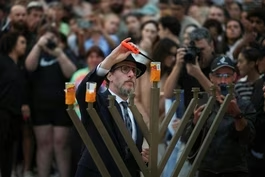
GEOFF BENNETT: Now to the massacre at Hanukkah gathering at Sydney's iconic Bondi Beach.
Fifteen people were killed and one of two gunmen shot dead after a hail of gunfire tore apart celebrations for the first night of the Jewish Festival of Lights.
Australian officials quickly labeled the assault an antisemitic act of terrorism.
Today, shock and grief were matched by anger and urgent questions.
(GUNSHOTS) GEOFF BENNETT: Eyewitness video captures the moment two armed men opened fire at a Hanukkah gathering on Sydney's iconic Bondi Beach, confusion, panic, the sound of celebration giving way to terror, families running for their lives, a festival of light darkened by violence.
KOBI FARKASH, Eyewitness: And then I heard like a shot, like boom, like three, four, five shots.
I thought probably it's like fireworks.
GEOFF BENNETT: This Israeli tourist visiting Australia was filming the celebration when the gunfire erupted.
KOBI FARKASH: And then, like, I just run and run and run.
I didn't think anything.
And then, when I just stop after I feel like it's a safe place, I stop, and I just -- I was just thinking like, wow, this is -- felt like being -- the same like what happened in the 7 of October in Nova Festival.
People are celebrating, enjoy the moment, enjoy the holiday.
GEOFF BENNETT: That sense of shock and grief hung heavy today as members of Sydney's Jewish community gathered to mark the second night of Hanukkah, a ritual usually centered on joy and continuity carried out this time in grief and mourning.
Today, Australian Prime Minister Anthony Albanese called it a horrific act of antisemitism.
ANTHONY ALBANESE, Australian Prime Minister: Tragically, in 2025, we live in a dangerous time.
And these two evil people have engaged in this act of antisemitism driven by ideology.
GEOFF BENNETT: But the attack has also sharpened political tensions.
On Sunday, Israeli Prime Minister Benjamin Netanyahu criticized Albanese and his government's decision to recognize a Palestinian state.
BENJAMIN NETANYAHU, Israeli Prime Minister: On August 17, about four months ago, I sent Prime Minister Albanese of Australia a letter in which I gave him warning that the Australian government's policy was promoting and encouraging antisemitism in Australia.
I wrote: "Your call for a Palestinian state pours fuel on the antisemitic fire."
GEOFF BENNETT: The Australian prime minister rejected that, instead calling for national unity.
QUESTION: Do you accept any link between that recognition and the massacre in Bondi?
ANTHONY ALBANESE: No, I don't, and overwhelmingly most of the world recognizes a two-state solution as being the way forward in the Middle East.
This is a moment of national unity where we need to come together.
And, in particular at this time, we need to wrap our arms around members of the Jewish community who are going through an extraordinarily difficult period.
DONALD TRUMP, President of the United States: That was an antisemitic attack, obviously.
And I just want to pay my respects to everybody.
GEOFF BENNETT: In Washington, President Trump also condemned the attack and highlighted an act of extraordinary bravery.
DONALD TRUMP: A very, very brave person, actually, who went and attacked frontally one of the shooters and saved a lot of lives.
(GUNSHOTS) GEOFF BENNETT: That man, an Australian fruit vendor, Ahmed el Ahmed, charged toward danger, tackling and disarming one of the gunmen.
MOHAMED FATEH AL AHMED, Father of Ahmed el Ahmed (through translator): When he saw these people on the ground covered in blood, his conscience and morals compelled him to attack one of the terrorists.
GEOFF BENNETT: Ahmed was later shot by the second gunman.
He's now recovering in the hospital.
MALAKEH HASAN AL AHMED, Mother of Ahmed el Ahmed (through translator): I'm proud that my son saved lives.
He was hit by bullets in the hand and shoulder, but Allah won't hurt him, as he was doing good.
GEOFF BENNETT: Half-a-world away, in Tel Aviv, a vigil was held for the victim, candles lit, prayers whispered and grief shared.
The impact is deeply personal.
Nir Golan is visiting Tel Aviv, but is from Bondi Beach.
NIR GOLAN, Bondi Beach Resident: This is our community.
This is our school.
This is our synagogue.
This is our backyard.
This is a tragedy, and we are still processing what has happened.
GEOFF BENNETT: Golan says the attack has shaken his faith in Australia's ability to protect Jewish citizens.
NIR GOLAN: I have told every person I have been here that Australia is no longer safe for Jewish people.
So this is not unexpected.
The government has done nothing to protect us, and unfortunately this is a situation we're in.
It is tragic.
My heart goes out to everyone back home.
GEOFF BENNETT: Australian couple Harry and Tammy Graeve were in Israel working as volunteers with a nonprofit group when they learned what had happened back home.
TAMMY GRAEVE, Australian Volunteer: We come here to help this country.
We go home.
What do we do to help our country?
What can we do?
HARRY GRAEVE, Australian Volunteer: It was a huge shock, and the world seems to have just turned upside down.
GEOFF BENNETT: Harry Graeve says this is a turning point for the Jewish community in Australia, but that they have to go on.
HARRY GRAEVE: We have to continue to have our Hanukkah events.
Christians have to continue having their Christmas events.
Otherwise, the bad guys win.
We cannot let that happen.
GEOFF BENNETT: A community shaken, but determined to remain visible, to choose light even in the darkest moments.
In the day's other headlines: Authorities in California have arrested the younger son of Rob and Michele Reiner after the director and his photographer wife were found dead this past weekend.
Police say Nick Reiner, seen here with his family, was booked for murder and is being held without bail.
It was not immediately clear what charges he faces.
The "When Harry Met Sally," director and his wife were found with stab wounds yesterday in their home in Los Angeles in what police are treating as a homicide.
We will have more on Rob Reiner's life and career later in the program.
Separately, in California, federal officials say they foiled a bomb plot that was set to take place at several locations in Southern California on New Year's Eve.
At a press conference today, DOJ officials said they arrested four people last week after surveillance footage showed them testing explosives in the desert outside Los Angeles.
Authorities alleged the suspects belonged to an extremist offshoot of a pro-Palestinian group dubbed Turtle Island Liberation Front.
They face multiple charges, including conspiracy and possession of a destructive device.
In Western Washington state, officials ordered immediate evacuations for three Seattle suburbs today after a local levee broke.
It follows days of heavy rain and flooding that have swamped communities.
The National Weather Service issued a flash flood warning for nearly 47,000 people and warned that routes of escape could be lost at any time.
Meantime, on the opposite coast, residents across the Northeast have been digging out from a weekend snowstorm.
Crews cleaned up several inches of snow in New York and New Jersey, the region's first major snowfall of the season.
U.S.
officials say that Washington and Europe are offering Article 5-like security guarantees to Ukraine as part of talks aimed at ending its war with Russia.
The reference to NATO-style protections come as Ukraine's president met with European leaders and U.S.
mediators in Berlin today.
The officials also said there is consensus on about 90 percent of the outstanding issues between Ukraine and Russia, but disputes over things like territorial matters remain unresolved.
Speaking to reporters, Ukraine's President Zelenskyy said he believes American mediators can help find a compromise on such issues.
VOLODYMYR ZELENSKYY, Ukrainian President (through translator): I believe that the issue of territories is a painful one, because Russia wants what it wants and we can't go any further.
But, of course, we need to find dialogue, and we will do everything to find clear answers to the questions of security guarantees, territories and money as compensation for Ukraine.
GEOFF BENNETT: In a joint statement after the talks, European leaders said they have remained committed to providing robust security guarantees to Ukraine, including a European-led multinational force supported by the U.S.
Chile is set for its most right-wing government in decades after ultra-conservative Jose Antonio Kast won Sunday's presidential run-off.
Kast spoke to supporters in Santiago as the results came in late yesterday.
During the campaign, he had promised to crack down on crime and immigration.
His victory is the latest in the political shift rightward across Latin America, including in places like Argentina and Bolivia.
In France, workers at the Louvre Museum are on strike after talks broke down over better working conditions, among other concerns.
Striking workers shut down the museum by blocking its iconic glass pyramid entrance.
It's the latest setback for the world's most visited museum after thieves made off with more than $100 million worth of jewels back in October.
Four arrests have been made, but none of the artifacts have been recovered.
On Wall Street today, stocks ended a touch lower ahead of tomorrow's November jobs report.
The Dow Jones industrial average slipped about 40 points, so nearly unchanged.
The Nasdaq fell more than 130 points.
The S&P 500 also posted a small loss on the day.
And "General Hospital" star Anthony Geary has died.
He's best known for playing Luke Spencer on the hit daytime drama.
The romance with Laura Webber played by Genie Francis became a cultural phenomena.
ANTHONY GEARY, Actor: I, Lucas Lorenzo Spencer... ACTOR: Take thee, Laura Webber Baldwin.
ANTHONY GEARY: Take thee, Laura Webber Baldwin.
GEOFF BENNETT: Some 30 million people tuned in to watch their wedding in 1981.
To this day, it's the highest rated soap opera episode in American TV history.
Starting in 1978, Geary appeared in nearly 2,000 episodes of "General Hospital," winning a record eight daytime Emmys along the way.
Anthony Geary was 78 years old.
Still to come on the "News Hour": Tamara Keith and Amy Walter break down the latest political headlines; we look back at the life and legacy of the late filmmaker Rob Reiner; and a "News Hour" tradition, members of the Armed Forces Band perform a holiday song.
Hong Kong's High Court found media mogul and pro-democracy activist Jimmy Lai guilty today of conspiracy to collude with foreign forces and sedition.
The high-profile trial took place under a national security law imposed by mainland China in 2020, which punished people not only for what they did, but also what they said, anyone who -- quote -- "provoked the hatred of Beijing," who called for Hong Kong separation from mainland China, who received support from a foreign country, as judged by Beijing-backed courts.
Sentencing will take place next month.
Lai, who was 78 years old, could be sentenced to life in prison.
President Trump today weighing in.
DONALD TRUMP, President of the United States: I feel so badly.
I spoke to President Xi about it and I asked to consider his release.
He's not well.
He's an older man and he's not well.
So I did put that request out.
We will see what happens.
GEOFF BENNETT: Jimmy Lai arrived in Hong Kong at just 12 years old, stowing away on a fishing boat.
He rose from factory worker to become a media tycoon and one of its most outspoken pro-democracy voices.
In the summer of 2020, he became the highest-profile figure arrested under China's newly imposed national security law.
And for perspective on this, we're joined now by Claire Lai, Jimmy Lai's daughter.
Thank you for being here.
CLAIRE LAI, Daughter of Jimmy Lai: Thank you so much for having me.
GEOFF BENNETT: You have described this as a life-or-death situation, not just a legal case.
When you think about your father right now, what feels most urgent?
CLAIRE LAI: Definitely his health.
I mean, my father was a extremely robust and strong man going in when he first went in five years ago.
And his health, I mean, I have just watched it deteriorate over the last five years, but a lot more alarmingly in the last two years.
He's diabetic.
He has heart issues, despite having a perfectly healthy heart five years ago.
He has high blood pressure, much higher than it was a year ago.
He has nails that are falling off and turning colors.
He has rotting teeth.
He has waste and back pains.
He has failing eyesight and failing hearing.
He has infections that last months, despite taking antibiotics.
And he just had so, so many health issues to list out.
And we're just extremely, extremely worried about him.
GEOFF BENNETT: You heard President Trump's remarks.
The secretary of state, Marco Rubio, also issued a statement today saying: "We urge the authorities to bring this ordeal to an end as soon as possible and to release Mr.
Lai on humanitarian grounds."
Is there still meaningful space for a diplomatic effort to secure his release?
CLAIRE LAI: Absolutely.
I mean, I have said ever it before, but having sat through every single day of the trial, I mean, I think what it shows is that it doesn't even live up to the name of a show trial.
It won't live up.
It won't be through the once promising, but now highly compromised Hong Kong legal system that this is solved.
And it has to be solved between world leaders.
And we are extremely, extremely grateful for President Trump, Secretary of State Rubio and the entire administration for their continued support.
They have had a proven track record of freeing the unjustly detained and we hope that our father will be next.
GEOFF BENNETT: I read the piece you wrote in The Washington Post last week.
And you said: "Even though the Chinese government disagrees, I believe setting him free would be to the government's advantage."
Walk us through that.
Why would releasing him serve China's interests?
CLAIRE LAI: I mean, firstly, it's the only just and it's the only honorable to do.
And it's the benevolent thing to do.
My father has already been in jail for five years.
A lot of the things he suffers from are not really - - are not the natural byproduct of prison.
He's denied the holy communion.
He's -- natural sunlight is blocked off.
He's not allowed to get the rosary and denied external medical access and so on and so forth.
He has suffered enough.
And that is the benevolent thing to do.
And also, my father, he represents values that we all hold dear.
And he also represents everything good about what was once the financial crown jewel of China, you know, entrepreneurial spirit, ingenuity and all of those things.
And my father is a British citizen.
And he is this is -- this is -- if my father dies a martyr in prison, this is a stain on their history that they will not be able to live down.
GEOFF BENNETT: Denied communion, denied the rosary, and yet his faith is what sustains him.
CLAIRE LAI: Definitely.
We are so grateful.
I mean, I -- in the last five years, I have seen his body break down.
But he is sustained by the prayers of some very good people.
And he is -- every day, he wakes up in the middle of the night to pray and he wakes up before the crack of dawn to read the Gospel.
And I truly, we all truly believe that that is what protects.
That is -- despite his failing body, that is what protects his soul and what protects his mind.
GEOFF BENNETT: Why is his case resonating far beyond Hong Kong?
CLAIRE LAI: Well, because of what he stands for.
My father, I mean, he stands for truth.
He stands for freedom, the freedom of the press.
And he stands -- I mean, he -- despite what the judgment says, I mean, all that they have proven in the trial that by the time of mitigation will have taken more than two years is that my father is a good man, a man who loves God, who loves truth and loves his family.
And that is something that -- and who stands for all those -- the values we hold dear.
And that is something that we can all resonate with.
GEOFF BENNETT: Claire Lai, thanks again for your time this evening.
And our best to your family.
CLAIRE LAI: Thank you so much.
Thank you so much for having me.
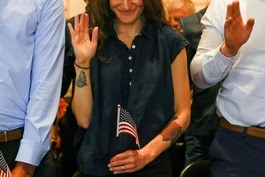
AMNA NAWAZ: It's the final step of a lengthy process to become a U.S.
citizen, the naturalization ceremony.
And in cities across the country in recent weeks, they have been abruptly canceled for immigrants from 19 countries that President Trump has deemed high-risk.
The cancellations follow the shooting of two National Guard members allegedly by an Afghan national.
The "News Hour" spoke to Marie, a Haitian woman who spent four years going through the citizenship process.
Her ceremony was slated for this Friday, but was canceled last week.
We're not showing her face or sharing her full name because of her fears over her status.
MARIE, Oath Ceremony Canceled: You try to do your best work hard, make sure you follow the laws and everything.
And then now you get to this print, and then you feel like, hey, what it this, after my hard work, everything that you do?
And then this is the result.
It's like a punch on the face, because I love America.
AMNA NAWAZ: For more, I'm joined now by Gail Breslow.
She's the executive director of Project Citizenship.
That's a nonprofit group that provides legal services to immigrants.
Gail, welcome to the "News Hour."
Thanks for joining us.
GAIL BRESLOW, Executive Director, Project Citizenship: Thanks for having me.
AMNA NAWAZ: So I want to make clear.
Marie is not one of your clients, but I understand some 20 of your clients were told they're not going to be able to go through with their nationalization ceremony.
Some were told on the same day of their ceremonies.
Just tell us what happened and how you learned about these cancellations.
GAIL BRESLOW: Yes.
Well, on November 27, the Trump administration put out a policy release from USCIS, U.S.
Citizenship and Immigration Services, announcing that they were going to be undertaking enhanced vetting and security measures in response to the tragic shooting that you alluded to in your lead-in.
And then I will just point out the irony of that.
November 27 was Thanksgiving Day, a holiday in this country celebrating all of us who have come here as immigrants.
Shortly thereafter, a few days after that, we began receiving phone calls and notifications on behalf of our clients that their oath ceremonies had been abruptly canceled.
One of our clients didn't receive the notice in time, although we had reached out to her, and by the time we connected with her, she had gone to Faneuil Hall for the oath ceremony that she had been scheduled for and told us that they were going down the line, they being officers, and asking every person what country they were from.
And depending on the answer that they gave, they were taken out of the line and told that their oath ceremony for that day was canceled.
AMNA NAWAZ: So, Gail, for anyone unfamiliar with the process, what does it take to become a U.S.
citizen?
How many years?
How expensive is it?
What kind of vetting do people go through?
GAIL BRESLOW: People go through extensive vetting to become U.S.
citizens.
First and foremost, you have to already have a green card, which is an arduous process in and of itself and involves vetting.
And then to be eligible for citizenship, you have to have had a green card for at least five years.
You have to be able to demonstrate knowledge of English, knowledge of civics.
There's a lot of scrutiny that goes on in terms of background checks that you go through as part of the citizenship process.
You have an in-person interview with a USCIS, or U.S.
Citizenship and Immigration Services, officer as part of the process as well.
It is long and arduous.
AMNA NAWAZ: We asked the administration for comment.
And we got this response from the Department of Homeland Security mentioning USCIS, the agency that you referenced.
They say they have paused all adjudications for aliens from high-risk countries while they work to ensure that people are vetted and screened to the maximum degree possible.
They say the pause will allow for a comprehensive examination of all pending benefit requests for people from those designated high-risk countries.
And they note the safety of the American people always comes first.
Gail, given what you just laid out in terms of the vetting, is it clear to you what their definition of the maximum degree possible of vetting means?
GAIL BRESLOW: Not at all.
I don't think it's clear to anyone.
I mean, this is a thinly veiled attempt to thwart people's efforts to become citizens of this country, in particular people from certain countries, from certain backgrounds.
These folks have already been fully vetted.
And this is, again, just a thinly veiled excuse to encourage people to leave this country.
I'm angry and ashamed at the actions that the administration is taking in this respect.
AMNA NAWAZ: So, Gail, I want to share for folks, this is a look at the 19 nations that have been deemed high-risk by this administration.
I'm not going to list them all here, but here's the map.
When you take a look at these, what is the common thread here?
Is there a higher risk for people from these nations?
GAIL BRESLOW: Not that I'm aware of.
I mean, when you look at what these countries have in common, the people who live there tend to be Black and brown people.
The people who live there often practice religions that aren't the most common in this country.
I can't think of any other reason why these countries would be singled out.
One of our clients, if I may, is a Haitian woman who has spent more of her life in this country than in Haiti, where she was born.
She has a teenage son.
She works as a certified nursing assistant.
She's been at the same job for over 20 years.
These are not criminals.
These are not people who need to be more thoroughly vetted than they already have been.
This is, again, just an excuse to turn this country into something other than what most of us are proud to be citizens of it for.
AMNA NAWAZ: So, Gail, what happens now for these clients?
Is there a possibility people who've gone through the process and come to the final step aren't able to fully become U.S.
citizens?
GAIL BRESLOW: People have that very question.
What we have been telling our clients is, as difficult as it is to hold tight for now while we wait for further information from USCIS -- it's been over two weeks and there's been nothing, even though their cancellation notices promise that, we will be back in touch with next steps.
Nothing has been forthcoming.
And we are at the same time exploring every legal avenue that might be available to us and our clients and are determined to fight for them and for the rights and privileges and benefits that they deserve.
AMNA NAWAZ: That is Gail Breslow, executive director of Project Citizenship.
Gail, thank you for joining us.
GAIL BRESLOW: Thank you for having me.
GEOFF BENNETT: President Trump receives rare backlash from members of his own party today for a social media post about the death of director Rob Reiner.
Meantime, Congress is running out of time to reach a deal on the Affordable Care Act tax subsidies.
For analysis, we turn to our Politics Monday duo.
That's Amy Walter of The Cook Political Report With Amy Walter and Tamara Keith of NPR.
It's great to have you both here.
AMY WALTER, The Cook Political Report: Good to be here.
GEOFF BENNETT: So, look, it was an incredibly callous and cruel post, even by Donald Trump's standards, about the deaths of Rob Reiner and his wife, Michele.
So, after the apparent homicides, the president wrote on TRUTH Social that their deaths were a very sad thing and that they would rest in peace.
But most of the post focused on attacking Reiner for his anti-Trump politics.
And the president even suggested that Reiner had brought his death upon himself through what Trump called Trump derangement syndrome.
What makes this moment different, you both know, is the response.
You have Republicans, not just Trump critics, but Republicans in battleground districts, members of Congress, pushing back, including New York Congressman Mike Lawler, Oklahoma Congresswoman Stephanie Bice.
You have also got a number of several conservative commentators also saying that this is really just depraved.
What do you make of Republicans breaking rank here?
AMY WALTER: Yes, I think there is still a lot of grief over the murder of Charlie Kirk.
And, remember there was a lot of consternation by many in conservative circles about the way that they believed people on the left were treating that murder.
There were many callous tweets and responses from some about Charlie Kirk's murder.
And the approach that some conservative movement took was to say we need to have an absolute truce to this kind of language, that, regardless of anyone's political opinion, something horrible happens to them, we do not go and use that as political beliefs against them.
In this case, the president did not.
What's different, you're right, though, is the fact that individual members of Congress and members of the sort of MAGA faithful coming out and overwhelmingly pushing back.
I think a lot of this is this a feeling that the president in this case is taking what they had hoped to be a sort of moral high ground and had undercut that.
GEOFF BENNETT: Tam.
TAMARA KEITH, National Public Radio: Yes, I mean, you did see some members of Congress contorting themselves to try to defend the social media post.
President Trump himself was asked about the pushback that he was getting, which you described many of it.
Marjorie Taylor Greene, congresswoman from Georgia, very MAGA until recently, also pushed back.
If you looked in the comments on TRUTH Social, and that's a pretty self-selecting group, a lot of people in the comments were like, sir, are you sure?
Maybe don't do this.
But President Trump was asked about this pushback and he doubled down.
He was asked in the Oval Office.
He continued to trash Rob Reiner and his politics.
It seems very clear that Reiner's politics had nothing to do with his murder.
But President Trump often finds a way to make everything about himself, and that's also what that post did.
AMY WALTER: Yes.
GEOFF BENNETT: Well, let's move on.
We are heading into another week on Capitol Hill here with votes planned on the Affordable Care Act.
No agreement yet on extending the enhanced subsidies.
What, if anything, has actually changed?
Has anything changed since this stalemate started?
AMY WALTER: I know.
Well, there's a lot more conversation.
GEOFF BENNETT: Yes.
AMY WALTER: Just talking to folks today who are following this a lot more closely than I am, they have not given up the belief that something can happen on these health care subsidies, whether it's at the end of the year or the very beginning of next year, that, even as there's no cohesive agreement on this, there are two paths, it seems.
One is, goes through the regular order of things, have a vote, maybe an amendment that includes subsidies for the extensions, which many moderate Republicans want.
The other is to go around regular order with this so-called discharge petition.
It would mean that some of those moderates would have to join with more than 200 Democrats for a three-year extension.
Now, that -- if that second path happens, we talk a lot on here about the president's hold on his party, whether it is loosening.
That would be a sign that the president's grip is absolutely loosened if members of his own party are willing to team up with Democrats.
GEOFF BENNETT: Where is President Trump in all of this?
AMY WALTER: And that's the $5,000 million question.
He has been pretty unengaged, I think, is the best way to describe it.
He's talking about he wants health savings accounts, he wants the money to go directly to the people.
It's kind of like he's having a conversation that is completely different than the conversation that is happening on Capitol Hill.
And there's no momentum behind what he's talking about.
There's also no muscle behind what he's talking about.
He's not trying to force Republican members of Congress to do this thing.
He's just kind of musing about what would be an idea.
But there isn't real pen to paper.
There isn't a specific plan.
The House is voting this week on a measure from the speaker that does not include what President Trump was asking for.
The Senate voted on something that you could, if you squinted, you could say that was basically what the president was talking about.
It didn't get enough support because it turns out, to get things through the Senate, you still need a bipartisan majority.
You need 60 votes.
And that means you need some sort of compromise, which just isn't happening.
I will note, in terms of timing just very quickly, today is the deadline... to sign up for Obamacare plans in most states if you want your insurance to start on January 1.
So the deadline is here.
Yes.
GEOFF BENNETT: Yes.
And, Amy, you pointed our team to the interview that President Trump gave to The Wall Street Journal where he's talking big picture about his economic policy, to include health care.
And he more or less openly acknowledges that his economic policies may or may not translate into political wins for Republicans in the midterms.
I mean, what does that reveal about how the White House, how he is thinking about the potential political payoff from his economic agenda?
AMY WALTER: Right.
Well, his economic agenda and this health care agenda.
He knows that both of these things are critical to his party's ability to hold onto the House.
We know that he and members of his team pressured Republicans in these states to redistrict in order to help keep the House.
Here, you have two opportunities to help your party keep control of the House, health care and economic policies.
And yet he seems to be sort of taking a back seat and saying, well, in this interview specifically, he says, I guess, maybe 2026, it won't have kicked in yet, in other words, his economic policies kicking in.
But the other thing he says is, historically, it's very difficult for the party who's in the White House to keep the House.
This is also a very tenuous time for Republican members.
They're going home for the holidays.
This is when many of them have the sit-down with their families.
Should I run again?
What do we think?
Put in another two years, put in another six years.
They're seeing the president's approval ratings at an all-time low.
They're having this fight over health care, not able to come together.
There is obviously a lot of tension, intraparty tension within the House conference.
And now they see the president saying, well, I don't know.
It's really hard to win in a midterm year when you're the party in power.
It's not a great sort of send-off to those folks who are contemplating perhaps whether or not they want to come back and fight for their seat.
GEOFF BENNETT: And not a great start to a campaign, an aggressive campaign tour next year, where I'm told the president's going to go state to state and talk about his economic agenda.
And he's not yet confident that it will actually be able to deliver a midterm win.
TAMARA KEITH: Yes, he is distancing himself because he always distances himself from things that don't look like a sure thing to be a win.
A quote from this Wall Street Journal article that really stood out to me, he says: "I have created the greatest economy in history, but it may take people a while to figure these things out," essentially saying, well, it's the people's problem, not mine.
GEOFF BENNETT: Tamara Keith, Amy Walter, our thanks to you both.
AMY WALTER: You're welcome.
TAMARA KEITH: You're welcome.
AMNA NAWAZ: As reported earlier, the investigation into the murder of director Rob Reiner and his wife continues tonight.
Senior arts correspondent Jeffrey Brown looks back at his life and his work.
JEFFREY BROWN: Rob Reiner was born into show business, his father, Carl, a legendary television comedy pioneer whose credits included creating "The Dick Van Dyke Show," his mother, Estelle, an actress and singer.
He first came to national prominences Michael "Meathead" Stivic.
SALLY STRUTHERS, Actress: Where's your tie?
ROB REINER, Actor/Producer/Director: Well, I tried, Gloria, but it doesn't look good with an empty neck.
(LAUGHTER) JEFFREY BROWN: Shaggy-haired son-in-law to Carroll O'Connor's bigoted Archie Bunker in Norman Lear's game-changing sitcom that ran for eight seasons in the 1970s and brought Reiner two Emmys for best supporting actor.
ROB REINER: Hi.
How are you?
JEFFREY BROWN: His move to directing began with the 1984 mockumentary "This Is Spinal Tap."
ACTOR: There's some problems here.
I don't even know where to start.
ACTOR: You would like bigger bread?
JEFFREY BROWN: A spoof of an aging rock band that would become a cult classic.
He just recently brought out a sequel, "Spinal Tap II: The End Continues," then a string of hits in a wide variety of genres, including the coming of age tale "Stand By Me" in 1986, based on a Stephen King novel.
CHRIS SARANDON, Actor: Surrender.
JEFFREY BROWN: 1987's "Princess Bride."
CARY ELWES, Actor: Very well, I accept.
ROBIN WRIGHT, Actress: Will you promise not to hurt this man?
MEG RYAN, Actress: Yes!
JEFFREY BROWN: 1989's "When Harry Met Sally," co-written with Nora Ephron, starring Billy Crystal and Meg Ryan, a defining romantic comedy of its era.
That's Reiner's mother, Estelle, in one of the film's most memorable scenes.
ESTELLE REINER, Actress: I will have what she's having.
JEFFREY BROWN: "Misery," a horror film from 1990, was based on another Stephen King thriller.
JACK NICHOLSON, Actor: I don't give a damn.
JEFFREY BROWN: And the military courtroom drama "A Few Good Men" in 1992.
JACK NICHOLSON: I did the job.
TOM CRUISE, Actor: Did you order the code red?
JACK NICHOLSON: You're goddamn right I did!
JEFFREY BROWN: Starring Jack Nicholson, Tom Cruise, and Demi Moore.
It brought Reiner his only Oscar nomination for best film.
The movies would continue, as would his occasional acting, including in Martin Scorsese's 2013 film "The Wolf of Wall Street" with Leonardo DiCaprio.
Reiner would also become known for his activism on behalf of liberal political causes, including overturning a ban on same-sex marriage, first in California, then at the national level.
And he was a frequent critic of President Trump, calling him a threat to democracy.
Reiner spoke of his involvement in politics in a 2023 appearance on the "News Hour" marking the death of Norman Lear.
ROB REINER: But, from Norman, I got this idea that you could use your celebrity, you could use your fame, and you could do something good with it.
And I took that to heart, and I have done things with my celebrity that I probably wouldn't have done it had I not had that path.
JEFFREY BROWN: He also combined his art and politics, making the 2024 documentary "God & Country," a critique of the rise of Christian nationalism.
Reiner was married for 10 years to Penny Marshall, also an actor and director.
He adopted her daughter before their divorce in 1981.
He met Michele Singer on the set of "When Harry Met Sally," where she served as director of photography.
He later said falling in love with her led him to change the film to have a happy ending.
The couple had three children.
Their son Nick, now 32, and being held on suspicion of homicide, had spoken openly in the past about his struggles with drug abuse, including in 2016 for an interview with Amna on ABC News about the film "Being Charlie" directed by Rob and co-written by Nick about the story of a drug-addicted teen clashing with his famous father.
AMNA NAWAZ: Was there ever a moment when you thought, this is too much, I don't want him to know all this?
NICK REINER, Writer: The father character initially was -- it was harsh on him.
And I, believe it or not, was not wanting the character to be that villainous.
And it was hard for him for a while to think that I thought of him that way, and to convince him that that's not how I felt, but that fathers do get in that mode sometimes when they're trying to help their kid who is in danger.
I did think that.
I mean, the way -- the father was originally written as a very black-and-white bad guy, and I thought, oh, God, that's what Nick thinks of me.
JEFFREY BROWN: Today, tributes to Rob Reiner poured in.
Ron Howard wrote: "He proved to be a superlative filmmaker, a supportive colleague and at all times a dedicated citizen."
Kathy Bates, who starred in "Misery," told the "News Hour": "He was brilliant and kind, a man who made films of every genre to challenge himself as an artist.
He changed the course of my life."
Barack Obama wrote: "Beneath all of the stories he produced was a deep belief in the goodness of people."
Michele Singer Reiner was 70.
Rob Reiner was 78.
For the "PBS News Hour," I'm Jeffrey Brown.
AMNA NAWAZ: Finally tonight, we continue a "News Hour" tradition, asking members of the U.S.
armed forces to record and share a holiday song.
GEOFF BENNETT: Tonight, to celebrate Hanukkah, we bring you the song "Rock of Ages," which was composed in the 13th century.
This video was produced by the Pentagon's Defense Visual Information Distribution Service.
(SINGING) AMNA NAWAZ: And that is the "News Hour" for tonight.
I'm Amna Nawaz.
GEOFF BENNETT: And I'm Geoff Bennett.
For all of us here at the "PBS News Hour," thanks for spending part of your evening with us.
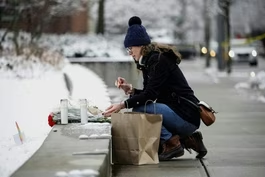
Brown Univ. student says there's still 'fear in the air'
Video has Closed Captions
Clip: 12/15/2025 | 9m 36s | Brown University student says there's still 'fear in the air' as hunt for gunman continues (9m 36s)
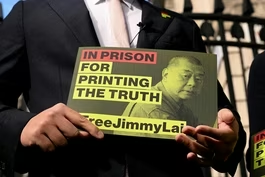
'He has suffered enough,' Jimmy Lai's daughter says
Video has Closed Captions
Clip: 12/15/2025 | 6m 35s | 'He has suffered enough,' Jimmy Lai's daughter says after his conviction in Hong Kong (6m 35s)
News Wrap: Federal officials say they foiled a NYE bomb plot
Video has Closed Captions
Clip: 12/15/2025 | 5m 13s | News Wrap: Federal investigators say they foiled a NYE bomb plot in Southern California (5m 13s)
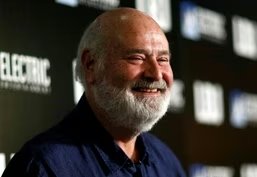
Remembering Rob Reiner's life and iconic career
Video has Closed Captions
Clip: 12/15/2025 | 5m 21s | Remembering Rob Reiner's life and iconic career (5m 21s)
Shock and grief matched by anger after Australia attack
Video has Closed Captions
Clip: 12/15/2025 | 6m 2s | Shock and grief matched by anger after antisemitic attack in Australia (6m 2s)

Tamara Keith and Amy Walter on Trump facing GOP pushback
Video has Closed Captions
Clip: 12/15/2025 | 8m 41s | Tamara Keith and Amy Walter on Trump facing GOP pushback over his comments on Rob Reiner (8m 41s)
Trump policies upend years-long paths to citizenship
Video has Closed Captions
Clip: 12/15/2025 | 7m 14s | Trump policies upend years-long paths to citizenship for some immigrants (7m 14s)

U.S. service members perform ‘Rock of Ages’ for Hanukkah
Video has Closed Captions
Clip: 12/15/2025 | 3m 51s | U.S. service members perform ‘Rock of Ages’ for Hanukkah (3m 51s)
Providing Support for PBS.org
Learn Moreabout PBS online sponsorship
- News and Public Affairs

FRONTLINE is investigative journalism that questions, explains and changes our world.

- News and Public Affairs

Amanpour and Company features conversations with leaders and decision makers.







Support for PBS provided by:
Major corporate funding for the PBS News Hour is provided by BDO, BNSF, Consumer Cellular, American Cruise Lines, and Raymond James. Funding for the PBS NewsHour Weekend is provided by...