
‘Dirtbag Billionaire’ tells story of Patagonia’s founder
Clip: 12/14/2025 | 6m 44sVideo has Closed Captions
New book ‘Dirtbag Billionaire’ tells story of Patagonia’s unconventional founder
Surveys consistently rank Patagonia as one of the most reputable brands in America, not just for its outdoor gear, but also for being good environmental stewards. The story of both the company and its iconoclastic founder is told in a new book, “Dirtbag Billionaire: How Yvon Chouinard Built Patagonia, Made a Fortune, and Gave It All Away.” John Yang speaks with author David Gelles for more.
Problems playing video? | Closed Captioning Feedback
Problems playing video? | Closed Captioning Feedback
Major corporate funding for the PBS News Hour is provided by BDO, BNSF, Consumer Cellular, American Cruise Lines, and Raymond James. Funding for the PBS NewsHour Weekend is provided by...
‘Dirtbag Billionaire’ tells story of Patagonia’s founder
Clip: 12/14/2025 | 6m 44sVideo has Closed Captions
Surveys consistently rank Patagonia as one of the most reputable brands in America, not just for its outdoor gear, but also for being good environmental stewards. The story of both the company and its iconoclastic founder is told in a new book, “Dirtbag Billionaire: How Yvon Chouinard Built Patagonia, Made a Fortune, and Gave It All Away.” John Yang speaks with author David Gelles for more.
Problems playing video? | Closed Captioning Feedback
How to Watch PBS News Hour
PBS News Hour is available to stream on pbs.org and the free PBS App, available on iPhone, Apple TV, Android TV, Android smartphones, Amazon Fire TV, Amazon Fire Tablet, Roku, Samsung Smart TV, and Vizio.
Providing Support for PBS.org
Learn Moreabout PBS online sponsorshipJOHN YANG: Surveys consistently rank Patagonia as one of the most reputable brands in America, not just for its outdoor clothing and gear, but also for being good environmental stewards.
That comes from its iconoclastic founder, Yvon Chouinard.
When he retired, he didn't cash out by selling the billion dollar company.
He transferred it to a trust that uses Patagonia's profits to combat climate change and protect undeveloped land.
The story of both the company and its founder is told in a new book, "Dirtbag Billionaire: How Yvon Chouinard Built Patagonia, Made a Fortune and Gave it All Away."
Earlier, I spoke with the author, David Gelles, a reporter on the New York Times Climate team.
I asked him to explain the book's title.
DAVID GELLES, The New York Times: Well, a lot of people hear the title and think, I must not have liked the guy.
But quite to the contrary, Yvon Chouinard himself actually calls himself a dirtbag in the climbing community that he came from.
A dirtbag is actually a term of endearment.
It refers to someone who's so unenamored with materialism that they're content to sleep in the dirt.
But when heard the title of the book, he actually didn't like it.
Not because of the word dirtbag, but because of the word billionaire.
He never wanted to be known as a billionaire.
JOHN YANG: Not only that, but he said he never wanted a company, he never wanted to be a businessman.
And so, of course, he ends up running a billion dollar company.
How did that happen?
DAVID GELLES: This is the great paradox at the heart of Yvon Chouinard's story and of the company Patagonia.
This is a man who grew up despising businessmen, who grew up loathing corporate America, and yet, nevertheless, he wound up running a company with more than a billion dollars in annual sales.
How that happened?
He wound up making products that people really liked.
And the only way to do that in this very imperfect system is by running a sort of conventional company.
JOHN YANG: And also, you mentioned he hated the term billionaire.
He was very irked when he got on the Forbes list of billionaires.
How did he handle that sort of psychologically and internally?
How did he deal with that?
DAVID GELLES: The day he was placed on the Forbes list of billionaires for the first time in 2017, he called it one of the worst days of his life.
He wound up stomping around the office, huffing mad, screaming at people, demanding that his lieutenants find a way to get him off that list.
But of course, it's not so simple, because he was indeed a billionaire on paper.
But ultimately, he and his family gave away the equity in Patagonia, which led to this really profound philanthropic transaction in 2022, where he renounced his ownership of the company.
JOHN YANG: Renounced his ownership.
And where do all the profits go now?
DAVID GELLES: All the profits from Patagonia, the company, that are not reinvested in the company itself, are donated to a series of nonprofit organizations that they set up, and that amounts to roughly $100 million a year.
JOHN YANG: You write that he was an outsider from the time he started grade school.
Was that sort of a thread that ran through his life?
DAVID GELLES: That started from a very early age.
He was raised in French Canadian Maine.
When he showed up in California when he was 10 years old with his family, he didn't speak English.
And so as he grows up as an adolescent, he finds himself sort of on the margins of polite society.
And that leads him first to being Falconer, which is to say he was actually going out and capturing birds of prey as a teenager, learning how to train them, and then as a rock climber.
And that leads to a series of other adventures, and then to him starting and then growing this business in Southern California that becomes known as Patagonia.
He's been an iconoclast and outsider his whole life, had started as an outdoorsman, but then, even as he became a very successful businessman, he did so in really unconventional ways.
JOHN YANG: Talk about that.
Because he did things that a normal retailer probably wouldn't have done.
He had a very popular product line that he just ended because he thought it was damaging rocks, damaging the earth.
DAVID GELLES: This is one of the patterns that repeats itself, this notion that Yvon Chouinard was willing to just disavow a popular product line if he discovered that it had a negative environmental impact.
He did it very early on when he discovered some of the climbing gear he was using was damaging the rocks that he was climbing.
And he did it again in the 1980s when he discovered that conventional cotton, which at the time was being treated with formaldehyde, all sorts of other toxic chemicals.
When he understood that, he said, we're switching to organic cotton.
Now, that meant sacrificing something like 20 percent of sales overnight.
But he said he was going to do it because it was more important to him to run a company that had high ethical and environmental standards than it was to just keep pursuing profits or even sales at all costs.
JOHN YANG: You talk about at the end, when he gave the company away, he said he hoped that he would influence a new form of capitalism that doesn't end up with a few rich people and a bunch of poor people, are there any signs that's worked, that influence has been felt?
DAVID GELLES: I think it's too much to ask one company, or even one individual, someone like Yvon Chouinard, to change the whole course of capitalism.
That's a tall order.
What I can say with confidence is that over the years, Patagonia really has had an impact on other companies and on corporate America at large.
And you can see its influence in groups like the Beat Court Movement, in groups like Time to Vote, the Sustainable Apparel Coalition, the Textile Exchange.
These are all initiatives that Patagonia and Yvon Chouinard actually helped start very quietly in the background.
And when you look to a new generation of CEOs who say that they're drawing their inspiration from Patagonia, from Chouinard, trying to do business differently.
There too, you can see the fingerprints of Patagonia.
But those I wish it weren't the case are still the exceptions that prove the rule.
The reality is, most companies are not like Patagonia today.
JOHN YANG: David Gelles, author of Dirtbag Billionaire.
Thank you very much.
DAVID GELLES: Thanks for having me.

Australia declares Bondi Beach shooting a terrorist attack
Video has Closed Captions
Clip: 12/14/2025 | 6m 25s | Australia declares Bondi Beach shooting a terrorist attack amid spike in antisemitism (6m 25s)
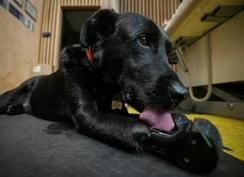
Dog with prosthetic paws inspires Ukraine’s wounded veterans
Video has Closed Captions
Clip: 12/14/2025 | 2m 12s | Dog with prosthetic paws inspires Ukrainian veterans recovering from wounds of war (2m 12s)

News Wrap: Zelenskyy meets U.S. envoys for talks to end war
Video has Closed Captions
Clip: 12/14/2025 | 1m 41s | News Wrap: Zelenskyy meets with Witkoff and Kushner for talks to end war in Ukraine (1m 41s)

Providence reels from deadly shooting at Brown University
Video has Closed Captions
Clip: 12/14/2025 | 6m 27s | Providence community reels from deadly shooting and lockdown at Brown University (6m 27s)
Providing Support for PBS.org
Learn Moreabout PBS online sponsorship
- News and Public Affairs

FRONTLINE is investigative journalism that questions, explains and changes our world.
- News and Public Affairs

Amanpour and Company features conversations with leaders and decision makers.






Support for PBS provided by:
Major corporate funding for the PBS News Hour is provided by BDO, BNSF, Consumer Cellular, American Cruise Lines, and Raymond James. Funding for the PBS NewsHour Weekend is provided by...