Oregon Art Beat
Filmmaker Vu Pham; Jefferson Dancers and Blue Sky Gallery each celebrate half a century
Season 27 Episode 7 | 33m 55sVideo has Closed Captions
Filmmaker Vu Pham; Jefferson Dancers and Blue Sky Gallery each celebrate half a century
In 1975, a scrappy group of Portland photographers created Blue Sky Gallery. 50 years later, it remains on the cutting edge of the artform. Portland-based independent filmmaker Vu Pham explores the Vietnamese diaspora following the 1975 fall of Saigon. Many schools have dance programs, but the Jefferson Dancers are nationally renowned, their 50-year legacy a point of pride in the school community.
Problems playing video? | Closed Captioning Feedback
Problems playing video? | Closed Captioning Feedback
Oregon Art Beat is a local public television program presented by OPB
Oregon Art Beat
Filmmaker Vu Pham; Jefferson Dancers and Blue Sky Gallery each celebrate half a century
Season 27 Episode 7 | 33m 55sVideo has Closed Captions
In 1975, a scrappy group of Portland photographers created Blue Sky Gallery. 50 years later, it remains on the cutting edge of the artform. Portland-based independent filmmaker Vu Pham explores the Vietnamese diaspora following the 1975 fall of Saigon. Many schools have dance programs, but the Jefferson Dancers are nationally renowned, their 50-year legacy a point of pride in the school community.
Problems playing video? | Closed Captioning Feedback
Where to Watch Oregon Art Beat
Oregon Art Beat is available to stream on pbs.org and the PBS app.
Providing Support for PBS.org
Learn Moreabout PBS online sponsorship- Support for "Oregon Art Beat" is provided by: Jordan Schnitzer and the Harold and Arlene Schnitzer Care Foundation Endowed Fund for Excellence.
And OPB members and viewers like you.
Funding for arts and culture coverage is provided by ... (bright music) (intense industrial music) - It's like you're pushing your body to the limit, but your emotions are also getting pushed to the limit.
It feels like you're glowing.
- I've been dancing since I was three.
Whenever people would ask me where I wanted to go to high school, I was like, "I'm going to Jefferson so I can be a Jefferson dancer."
And I would have their posters like up on my wall.
(intense percussion music) - It's like you have on a mask all day, and then when I come to dance practice, I get to take off that mask.
It's really stress-free, yeah, so.
Dance is me, like, that's all I can say.
(intense industrial music) (soft ethereal music) - I'm really inspired by everyone who's come before me, and I feel so lucky, and it's also, like, a lot to think about and like carry because like I feel like I have this legacy on my shoulders, Especially as, like, a senior.
(soft ethereal music) - Yes, this is my.... Oh yeah, I'm a senior, like... I'm actually really excited to be a senior and like be a part of like the 50th anniversary.
Like, oh my god, I don't even know how to explain it.
I just have so many feelings about it.
It's very heavy, I'll be honest.
But it's really encouraging.
It's encouraging to the point where I wanna push myself more.
- I mean, the 50th anniversary, it's kind of hard for me to wrap my mind around it 'cause it's like every year that's a lot of kids who are just like us and who really just like love this form of art.
- Come in, everyone!
(students chatter) Sit for a second!
Let's talk through what we're gonna do today.
Everybody.
Big circle.
We're gonna start with Miss Lauren's piece, "Beneath the Break," okay?
Then let's do Harlow's.
Let's do hip-hop, let's do Piper's.
We also have to do "Old African," right?
I also would like to run "Rhythm" in there and "New African."
What am I missing?
(upbeat Latin music) Stretching side, right arm, seven, leaning.
And.
(upbeat Latin music) Plié first.
Being a Jefferson dancer meant, honestly, the world to me.
It was something I think I only dreamt about.
I mean, my years in the company were '83 to '86.
Then I came back in '99 to take over as artistic director.
- [Bunky] The amount of dedication it takes to be a Jefferson dancer was exactly the kind of push and drive I needed.
- Because you were an athlete.
- Oh yeah, basketball player.
Completely converted myself.
The intensity, the energy that I put out when I'm performing.
There's no greater joy.
- [Steve] Left.
- I never thought that I was going to be a teacher.
- Yes, I never thought I'd be a teacher.
That was not even in my spectrum.
I enjoy it so much, though.
I can't express how much I enjoy teaching these young artists right now.
Yeah, I got it now.
Okay, from the side you go out and fifth, out and fifth, developpé, enveloppé, and pas de bourrée.
And over plié.
Step up to fifth.
Pas de bourrée.
Then you're on the other side.
Is that clear?
Out, ba.
Dee, da... Yeah, that's probably where you got it from.
Pas de bourrée.
Other side, one and a two and a three and a four.
Developpé and enveloppé.
We do have high expectations.
They know how difficult it is.
They know they have to be pushed, and they know they're being watched by alumni.
And they want to be just as good.
So they work really hard.
They want that for themselves.
- [Musician] Bunky!
Any requests?
- We will get into pushups, sit-ups, the whole nine.
Five, six, seven, eight, down.
One, two, three, four.
It is a delicate thing when you are pushing them, and that's a balance for us sometimes when we are knowing who to push, when to push them.
We both come from a nurturing place, but nurturing with expectations 'cause we believe they can all succeed.
♪ Halo, halo ♪ ♪ Hit me like a ray of sun ♪ - You got this.
Stand up tall.
Standing leg, standing leg, standing leg.
♪ I'm addicted to your light ♪ - Good.
The words, I can't, does not exist in our vocabulary.
- [Bunky] I always say find another way to say it.
Yeah, "I'm challenged, this is hard."
"You believe I can do this?"
Yeah.
All of those things are daily reminders for them.
(music continues) - Seven, and a eight, and a. Yeah, it's like seven, and a eight, and a. All over the place.
- Seven, and a.
- C'mon!
(soft ethereal music) (soft ethereal music continues) - It's a piece about how our dreams and our unconscious thoughts, they can be kind of scary sometimes.
I feel like they can also show us a lot about ourselves.
(soft ethereal music continues) - We spend so many hours.
I think Bunky and I see them for five hours a day.
Probably longer than they spend with their own family and friends.
We created a safe space that we can all feel comfortable and be real with each other.
We can't fake our way through life.
We're gonna get through it together.
♪ I think you know what this is ♪ ♪ I think you wanna ♪ ♪ No, you ain't got no Mrs.
♪ ♪ Oh, but you got a sports car ♪ ♪ We can uh-uh in it ♪ ♪ While you drive it real far ♪ ♪ Yeah, you know what this is ♪ ♪ Yeah, you know what this is ♪ - I think being at Jefferson has affected my life in every single aspect.
- Oh my god, school would be so much worse without the Jefferson dancers.
(upbeat hip-hop music) I was super shy in middle school.
I didn't have a ton of friends.
And I would not be the same person without it.
♪ Go get the mop for me ♪ ♪ I'm cleanin' up the poser with no apology ♪ ♪ You Debbie downers need to drown with animosity ♪ (soft ethereal music) - Jefferson has so much community and love, and I've never felt more of it than I do in the dance program.
So to be a Jefferson dancer, to me, means like carrying that on as well as dance.
And it's, like, art and it's inspiration, and it's doing stuff for your community.
- [Piper] It's titled "Through," and it's the concept of you can try and cover up how you feel, but it will eventually get to you, and you need to feel your emotions to get through them.
(upbeat electronic music) - Sometimes, I hate to say this, but I find myself in tears when it's senior year.
'Cause I'm, like, we're just scratching the surface of who you are and what you are as an artist or as a dancer, and you're going to go off into the world.
And that process is just beautiful in so many ways.
- I'm always like, I'm gonna be like, "I'm not gonna cry, I'm not gonna cry, I'm not gonna cry."
I'm definitely gonna cry.
Like I'm getting taken away from my home.
Like dance, like Jeff, like the JDs.
It's really like a place where I built my community.
- [Interviewer] It won't be the end of dance for you, though, I bet.
- Oh no, oh no.
That's, this is starting my career, yeah, definitely.
- There's a lot of history here in this building, this 1909 building.
And, you know, a lot of talent has walked through that room.
(sentimental music) I'm a little bit sad that that's going to be gone, but I'm also excited for the future of the school and to have a new space where, you know, we can have another 50 years of the next generation that will be as creative and inspiring and resilient and hardworking.
[Dancers] Thank you.
[Dancers] Thank you!
(students chatter) (soft piano music) - This documentary is called "Sea Rose Ashes."
We came from the sea, an immersive, expansive, extremely intimidating entity.
My mom's name, Hong, means rose, and her ashes for me suggests that there is a cycle of time and life.
Like pouring into life from out of the sea, being the rose and returning to kind of a state of finality on the other side.
(soft ethereal music) I just need a rehearsal on this.
I just wanna see the action.
So, let's take it from... Since 2010, I've largely considered myself to be a narrative filmmaker.
I work in the world of fiction, of make believe.
(foreboding music) (chaotic music) And, lo and behold, my life runs into reality, which is this struggle to reveal to myself the mystery of my mom's life and death.
And that process led me to the documentary filmmaking world.
During a lull of work, I decided I would take this personal southeast Alaskan adventure.
On March 17th, 2020, I flew into Juneau, Alaska, landed.
My friend picks me up, tells me, "Hey, so bad news.
The entire state is shut down."
During COVID, there was very few people there doing anything publicly.
And so I pretty much was a stranger in a strange land in a strange time.
When there was no one else and nothing else to seduce you, not even your devices, not even technology.
Wherever I went, there it was.
It was just my own demons looking right back at me.
And that was the tormented life of my own mother.
(foreboding music) We arrived in the United States in November of 1981 as boat refugees by escaping the communist government in Vietnam.
She did her best to try and assimilate, but, you know, the language is a challenge.
Cultural connection is a challenge.
And so, you know, a group of immigrants kind of have to find a way to socially cooperate and cohere to weather the storm of a foreign land.
And so one of the men that she naturally gravitated towards has been here for about a year.
He has a job, he seems to know the language a little better.
And he seems very interested in her, in me.
He was a man that I hung out with, you know, and he was a father figure to me.
We were in the bottom floor in one of these apartments here.
I don't remember which one.
At some point in time, my mother decided that he wasn't the right man for her.
And she tried to break up with him.
But no matter what she did, he wouldn't go away.
And, sadly, tragically, this is also where my mom died.
(reflective music) Through the assistance of a private investigator friend, I was able to locate him and begin writing a series of letters, to which he has not responded to.
The DA file was made known to me in 2024.
I decided to read it cover to cover.
It was as if I had lived all of my life in some dark cave and then one day saw the pinhole of light from some other end and stepped outside into pure sunlight.
- Yeah, did it.
- OK, there we go.
Because there was so much that I had not understood about the lives of these refugees, about the perpetrator, about the legal system, about law enforcement.
I realized that this was another opportunity to marry life and art in a way that I've become so familiar with.
- Vu came to us for a restorative justice process with the person that murdered his mother.
I offered him the solution of a surrogacy.
In a situation where a party doesn't wanna participate or is unable to participate and have a dialogue with the person they harmed, we bring in a surrogate who had similar harm happen.
And then they come in and tell their story so the person that caused the harm can actually see the impact of what they've done.
From that, because Vu does video, we decided to work on a project.
- [Vu] Cool, all right.
Our first interview is here, so, I'm gonna just come and grab him.
My role here is to be the producer, director, and campaign strategist for a digital storytelling campaign.
And that campaign is centered around victim survivors' voices and their stories.
I couldn't think of a more personally meaningful way to use my skills than to do this and to help others out.
- Camera Assistant] Scene Sam, Take 1, common marker.
- So, tell us what you do remember to the point when you woke up again.
After you were shot, were you conscious for a little bit?
I mean, you were conscious enough to yell for help.
- People need to listen to those that have been harmed, and, most often, all of us that have been harmed are looking for a relational-type repair.
- So, talk to me as if I were in your shoes and I wanted retribution.
I wanted punishment for him.
Explain to me like why I should forgive this person or even attempt to make contact with him.
(upbeat Vietnamese music) In the process of doing all of this, my uncle connected me to my aunt in Vietnam.
And my aunt, after a few months of beginning to get to know me through a series of weekly video chats, asked me if I could exhume my mother's remains, cremated, and bring her ashes back to Vietnam, to be where her relatives and her ancestors were also buried.
(reflective music) (case clattering) (reflective music continues) I was able to return to Vietnam and shoot for about a week with Kevin Forrest, my DP.
As a narrative filmmaker, I've always asserted a level of control in design.
And with documentary filmmaking, there is a much more spontaneous and loose kind of approach to it.
With subjects as opposed to actors, you're setting the stage or the environment and provoking through questions, and those questions are the sort of equivalent of directorial guiding that you do as a director.
(Vu speaks Vietnamese) This is (beep) crazy, dude.
He was here with my mom.
So, the last time he saw me was here, and now the first time he's seen me since then is right here.
Weird (beep).
(Vu speaks Vietnamese) (Interviewee speaking Vietnamese) As I take on the role of an editor is also one in which I have sort of a new relationship to the subject of my films.
Some of the subject matter being my aunt and my cousin, you know, are people that I care personally about.
And now being able to sit down and look at their interviews and stare at their faces and look at their gestures and capture every little, you know, glimmer of nuance is as if I am making up for 43 years of lost time through every frame of their image.
(gentle music) - Living in silence of things that happened is not healthy.
I believe stories change the world, and the world changes our stories.
So we need to tell them to change the world in a way we want to see it become.
- [Vu] I just want cinema to stir feeling, provoke thought, and then carry all that into the world in dialogue, in conversation, in self-examination, and self-exploration.
That's a very satisfying result of a labor of love.
(reflective music) (reflective music continues) (upbeat music) - These are the pictures for the second decade show.
So, I'm just laying it out to see how things fit.
- [Narrator] Portland photographer Christopher Rauschenberg has got his work cut out for him.
- I think it's 381 prints.
So, this is gonna be a lot to look at.
- [Narrator] Along with tracking down hundreds of photographers, he's curating five separate exhibitions, each focused on a decade in Blue Sky Gallery's 50-year history.
- One side of the gallery will be three pictures from shows that we had during that decade, and then facing across from it mirror-wise will be three newer pictures by the same artist.
- [Narrator] It all started back in 1975 when photographers Ann Hughes and Bob DiFranco found themselves with some extra space at the front of their dark room.
- Craig Hickman, one of the other co-founders, said, "Well, we could kind of have a gallery."
And Ann thought about it and she said "Well, that'd be good 'cause then if a photographer comes to town, they'll come to the gallery and we'll meet them."
So, the gallery was kind of conceived as kind of a honey trap to meet photographers.
- [Narrator] Chris, along with friend Terry Toedtemeier, joined the group, and the five began converting the 9-by-11-foot space on Northwest 23rd Avenue into one of the first American galleries devoted entirely to the art of photography.
- [Christopher] Originally, we thought we would just show local photographers, but once we opened the gallery and Ann Hughes's beautiful posters started getting mailed out nationally, we were getting show proposals from all over the country.
We didn't really realize that this was gonna go on for anything like 50 years.
It just has kept on.
I mean, if you're doing something that is really actually useful, you find it self-sustaining in a certain kind of way.
- [Narrator] Today, Blue Sky still operates much as it did at the start, from welcoming submissions from literally anyone free of charge.
- [Narrator] To inviting members to decide what work is shown on the gallery's walls.
- [Gallery Member] But he's crafted them so well that that's not a detraction to me.
I think that just speaks to his skill.
- Okay, so who's seen this before and would like to show it?
Who'd like to hold it?
Who'd like to not hold it?
Okay, that's a show.
(bright music) - When Blue Sky first started in the '70's, it put Portland on the map as a place that would show photography in a gallery.
It also then became just critical to really creating this space here in Portland that was a window into the rest of the world.
(bright music) We also continue to create spaces for local artists.
So, we have the Pacific Northwest Drawers program where we select 60 artists that get to show a series of 10 prints in the drawers all year long.
- [Narrator] Each fall and spring, local artists with work in the drawers meet the public in an event known as the Print Walk.
- Okay, is everybody in the front room?
Great.
Thank you all for being here today.
We're super excited.
This is a great opportunity for the artists that are featured in the Pacific Northwest Drawers to talk with folks about their work, how they made the work, and what goes into it.
(audience applauds) - My name's Allen Myers, and I live in Portland, Oregon.
And in 2018, my parents' home burned down in Paradise, California.
I returned home to see what I could do to just be part of my own healing process.
And there was a moment where my parents were standing in the ashes of their home.
I knew that it was something that needed to be preserved.
(somber music) What I've come to see and understand is that these incredibly painful places, our instinct is to run from them.
And that in order for us to really make sense and to heal, there needs to be a moment of pause.
The photography provides an opportunity for participants to stand in that pain, to be seen in it, to sit with it, and then to begin to step into a new future, whatever that might be.
- Just like making these mini still-lifes.
A home can tell you a lot about a person without seeing them.
My name is Wyndi DeSouza.
I am from Newark, New Jersey.
My grandmother was a really great image maker.
She's 92 now, and I think she had so much to say but has not been able to tell that story because what times were.
A lot of the images are around her home, and it's her response to the question: "What home means to you?"
Her home is something she worked so hard for and means so much to her.
I learned about Blue Sky Gallery, and it was really, really important for me to just be a part of this institution that's been here for 50 years.
Also to like make myself be ingrained and be a part of the Portland art community.
It's been like my first step in.
- Over half of those are Portland.
And this is in Wyoming.
- I love a flat landscape.
Most people don't, but I love a flat landscape.
- You must have a beautiful garden.
- Every year, it's a new experience.
I'm Claudia Hollister, and I live in Portland, Oregon.
I started doing cyanotypes in 2014.
Cyanotype is a photographic process that goes back to 1842.
It was originally designed for blueprints.
You're using UV light to print instead of chemicals.
(upbeat music) Getting in the doors the first time was a huge confidence boost for me and trusting how I see things.
Being in them for now three years in a row has been a huge honor.
- We really have been putting a lot of energy into the photographers who are in the drawers and helping them to sell their work, helping them to get recognized.
We have an outside curator do the drawers, and it's a chance for a curator to find out about all the wonderful work that's in the Northwest.
So, it's always about how do we help the photographers.
As we looked forward at our 50th birthday, I realized that Blue Sky was in a unique position, having had a thousand exhibitions over the last 50 years, to create sort of a watering hole where photographers could go and look at the work that had happened over the last half century and discover somebody that they haven't heard of.
We try to do a lot on our website.
We have over 200 artist talks.
And we've put up a thousand webpages, so there's 10 to 20,000 images there.
We've tried to make as thorough a place to be inspired as possible.
- [Narrator] Showing 50 years of images in five gallery exhibitions spread over one year's time has taken work and creativity.
- So, we are just coming up on the second show from '85 to '95.
We're not just showing work that we've shown before, but, "Hey, what are they making now?"
To really kind of see how these artists have evolved.
- Oh look, there you are!
- I think there's a great energy from being here for the 50th anniversary.
The vibe has been kind of like a college reunion in some ways, it feels like.
I think, especially for the founders, they were friends in their early 20s when the gallery first started and built this incredible reputation.
People are just really proud that we have something so special here in Portland that's lasted so long.
- From the very beginning, it seemed like a nice communal thing to do together, and it's been something where you feel like you're just walking down the street, and you look behind you and you're leading a parade, 'cause what we were doing was so needed.
I've really found it so satisfying to be playing point guard on the photography team, and I've got the wonderful opportunity to help photographers further their careers by having exhibitions here.
And I find that tremendously satisfying.
(bright music) - To learn more about "Oregon Art Beat," visit our website, opb.org/artbeat.
And to see what we're working on now, follow us on Facebook and Instagram.
(bright music) (bright music continues) (bright music continues) (bright music continues) - Support for "Oregon Art Beat" is provided by: And OPB members and viewers like you.
Funding for arts and culture coverage is provided by:
Video has Closed Captions
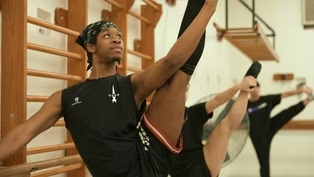
Clip: S27 Ep7 | 10m 43s | North Portland’s Jefferson Dancers Celebrate 50 years (10m 43s)
Video has Closed Captions
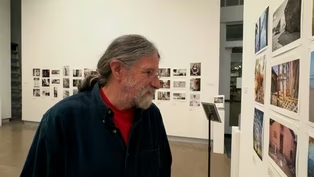
Clip: S27 Ep7 | 9m 42s | Blue Sky Gallery celebrates its 50th anniversary as Oregon’s hub for photographers. (9m 42s)
Vu Pham: exploring family, loss and the Vietnamese diaspora through film
Video has Closed Captions
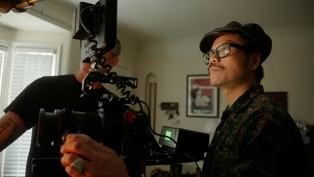
Clip: S27 Ep7 | 11m 41s | Vu Pham: exploring family, loss and the Vietnamese diaspora through film. (11m 41s)
Providing Support for PBS.org
Learn Moreabout PBS online sponsorship
- Arts and Music

Join the legend for a musical journey through the people and places that shaped her career.

- Arts and Music

Innovative musicians from every genre perform live in the longest-running music series.






 New Episode
 New Season
Support for PBS provided by:
Oregon Art Beat is a local public television program presented by OPB