
Here Comes Summer
Season 23 Episode 24 | 26m 46sVideo has Closed Captions
Celebrate summer with cool escapes and warm weather fun statewide.
Celebrate summer with cool escapes and warm weather fun statewide. Plus, explore a North Carolina landmark connected to the Revolutionary War.
Problems playing video? | Closed Captioning Feedback
Problems playing video? | Closed Captioning Feedback
North Carolina Weekend is a local public television program presented by PBS NC
Here Comes Summer
Season 23 Episode 24 | 26m 46sVideo has Closed Captions
Celebrate summer with cool escapes and warm weather fun statewide. Plus, explore a North Carolina landmark connected to the Revolutionary War.
Problems playing video? | Closed Captioning Feedback
Where to Watch North Carolina Weekend
North Carolina Weekend is available to stream on pbs.org and the PBS app.
Providing Support for PBS.org
Learn Moreabout PBS online sponsorship- This program is made possible in part by generous support from the American Battlefield Trust, connecting you to the places where our nation was forged.
Visit battlefields.org today.
[upbeat music] - Next on North Carolina Weekend, here comes summer.
So let's get out and explore.
We'll head to Grandfather Mountain for wide open views and high country thrills.
Discover the treasures of mining in Hiddenite and enjoy oysters at their freshest in Beaufort.
Coming up next.
- Funding for North Carolina Weekend is provided in part by Visit NC, dedicated to highlighting our state's natural scenic beauty, unique history, and diverse cultural attractions.
From the Blue Ridge and the Great Smoky Mountains across the Piedmont to 300 miles of Barrier Island beaches, you're invited to experience all the adventure and charm our state has to offer.
[upbeat music] ♪ ♪ - Welcome to North Carolina Weekend.
I'm Deborah Holt Noel, and summer is an invitation to get out and explore.
Our first stop is the iconic Grandfather Mountain.
With peaks rising nearly 6,000 feet above sea level, Grandfather Mountain offers miles of hiking trails and gorgeous views.
But we discovered lots more that will appeal to all kinds of travelers.
Let's take a trip to Watauga County.
- Grandfather Mountain is a nature park and preserve here in Linville, North Carolina.
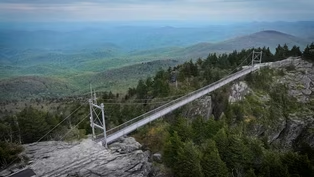
We're probably most known for the Mile High Swinging Bridge.
It's America's highest suspension footbridge.
It connects two peaks up here, gives people absolutely amazing views of the landscape around us, and it's also just a thrill.
We're also known for our animal habitats where we have black bears, cougars, otters, elk, and bald eagles.
We have the Wilson Center for Nature Discoveries, so it's just a really spectacular place for folks to come visit.
- Grandfather Mountain here in Northwest North Carolina was really a rugged backcountry location.
In the late 1800s, a large tract of land, about 16,000 acres, was acquired.
And then later, the Grandfather Mountain travel attraction became a destination, really starting with the founding of Hugh Morton's park in 1952 when he expanded the park road and built the Mile High Swinging Bridge.
Hugh Morton was just really an amazing person.
He had an incredible vision here at Grandfather Mountain, a huge economic driver for our local community, but he also, more than that, was a conservationist.
He recognized the importance of getting people connected to nature, and that's our mission today as a non-profit.
We know that people have to come to a place like this, fall in love with it.
If we love it, we'll protect it, and it'll be here forever.
(gentle music) - So the Yonnelassee salamander is one of a couple of different species of salamanders that was discovered here on Grandfather Mountain.
And it was found on what is now US Highway 221 that wraps around Grandfather Mountain.
At the time, it was called the Yonnelassee Road, hence the name, the Yonnelassee salamander.
And so as we were developing this space, we thought, what better tie-in for a space that is kid-centric, kid-focused, than to use our mascot, Yanni, for the Junior Nationalist Program.
And so we developed the name Yanni's Clubhouse, and so Yanni is scattered throughout this space.
He helps the kids learn, helps guide them, not only here, but throughout the park as well.
- In the '60s, Mildred the bear was our founding bear.
Eventually, they decided to build the first bear habitat around her and start a bear breeding program.
They don't need our help anymore.
We now have an estimated 20,000 black bears in the state of North Carolina.
And now, going forward, we're hoping to give a home to any new bears that may need our help.
- I have been bringing my family here for 15 years now.
We have been taking the standard picture with the bear statue in the lobby since they were infants.
So it's been really cool to see them grow.
And every time we've been here, it's been a wonderful experience, and that's what keeps us coming back.
Okay, it is my first time coming here.
I've been dying to come here.
It is gorgeous, whether there be fog, rain, whatever.
It is stunning views.
It's just a staple that you have to come and do if you're in the area.
- We offer dozens of programs from April through October, and we really encourage our guests to take advantage of those.
If you're planning a trip in advance, check out that schedule and try to incorporate some of those into your visit.
- You know, Grandfather Mountain is an iconic natural destination, international biosphere.
Over 70 rare and endangered plants and animals that call Grandfather Mountain home.
More than 200 bird species live here in the summer months.
And we hope the visitors come today.
They cross the Mile High Swinging Bridge.
They see the beauties of Grandfather, the wonders.
But we really do hope they leave changed, having a love and passion for the natural world.
We just hope that they're good stewards of what they're responsible for.
And that's really the overall lesson that we try to focus on here at Grandfather Mountain.
[upbeat music] - Grandfather Mountain is open daily year round, though hours vary by season.
For tickets, special events, and information about the new Yonni's Playhouse Nature Discovery Area, visit grandfather.com.
Areas of North Carolina's Piedmont and mountains are rich with gems and minerals hidden beneath the earth.
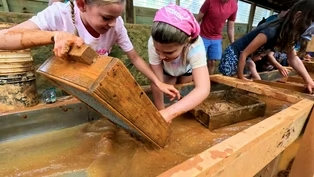
The Hiddenite community there in Alexander County is home to Emerald Hollow, believed to be the world's only emerald mine, open to the public for prospecting.
And if you're lucky enough to find one, it's yours to keep.
Teresa Litschke shows us what makes this a fascinating summer adventure.
♪ - How do we know those emeralds?
Why are there emeralds here?
Why are there minerals so dense here to start with?
There's about 65 different things you can find here.
All these hills that are around us are the convergence of five hills that come together.
So this area had to be incredibly active volcanically and just earthquakes, you would have had tremendous amount of ground movement.
So those voids make room for sediment and clay to get into that makes it mineral rich that they can form and grow.
It's gotta have enough compression to form a crystal, but be loose enough to let water and minerals congregate in an area and it can expand it.
- That's why gemstones are so prevalent in the red clay soil in Hiddenite, named after a man who put the town on the map.
- Go all the way back to William Earl Hidden, who was the guy that Edison sent to find the new burn bright element for the light bulb.
And they were looking for platinum.
And North Carolina's got platinum, just not here.
And it was an accident when they were digging and turning all this dirt over, couple rainstorms come through, next you know you got this mineral glistening, no one knew what it was.
They sent it off to France, where they had to identify as unknown mineral, spodumene and named it after itself, Hiddenite.
- That's in case we lose anybody, we gotta know who's driving what.
- Oh, okay.
- Safety is always first, along with an adventure like no other.
- Once we get you signed in, you have access to the entire property all day.
You can leave, go get lunch, come back, your permit's good all day.
- We're going to do the mining part first, and then after that, we'll go down to the creek.
Typically what we tell people is, go to the dig site first.
It's the hardest, especially if you get here early, spend your first couple hours there, we'll educate you on what you need to know.
Then ease out of it.
Go to the creek, relax, it's nice, and then end up at this loose way before you go home.
We provide everything.
Our shovels are all over here with buckets.
- We are mining for rubies, emeralds, gemstones.
- It's very personal.
Some people come and look for something specific like tourmaline.
We had a guy find almost two pounds in a vein.
Other people hunt the emeralds.
- Gems.
- Emeralds.
- Emeralds, yeah.
- We will teach them everything we know about the emeralds and the signs we know.
- The sparkly stuff is the mica.
Just remember what that means.
That was clay.
When it got heated, it turned into mica.
So if you want to find the gemstones, you have to bring dirt down here with mica in it.
- The number of people finding those special stones may surprise you.
- Many, many, on a regular basis.
It's the only active emerald mine, the only one in the entire world that you can come into and actually dig.
But we try to guide them in areas where we think they're gonna have the best chance, too.
So anything you find, you keep.
- Another way to mine is directly in the creek.
- I don't know exactly what this is, but it's a cool rock.
- That is a piece of dioptase.
Dioptase is a copper-based mineral.
It's a jasper.
Anything that doesn't allow light into it is gonna be a collection of a jasper.
- Rose quartz right here.
- All right, inside secret.
If you go to the end where it tees, this is where the sandbars end up.
And then if you catch the sandbars and rinse them in, that's where you're gonna find stuff that acts like a trap.
- Last stop is the sluice way to wash off the dirt and reveal the treasures you found.
- Oh my goodness.
- Even if you can't or don't want to mine the old-fashioned way, you can purchase enriched buckets that already contain amazing stones.
- The goal is to create a space here for everybody in the family, grandparents all the way down.
- We're excited.
- Some people can't navigate down here.
Some people can't navigate to the dig site.
So it's important for us to create space for them too.
Even our sluice way has sections we can take out for wheelchair.
- Look at these crystals.
- And have a full experience, have full interactions with everybody, get an education of what you're doing and enjoy it at the same time.
(upbeat music) - Emerald Hollow Mine is located at 484 Emerald Hollow Mine Drive in Hiddenite.
They're open 8.30 a.m.
till 5 p.m.
Monday through Friday and 8.30 till six on weekends.
For more information, give them a call at 828-632-3394.
From oyster farms to fishing piers, North Carolina's Crystal Coast is full of opportunities to enjoy seafood straight from the source.
Let's join producer Linda Nguyen as she makes a stop on North Carolina's oyster trail and discovers some of the people and flavors that make the coastal region so special.
(upbeat music) ♪ - It's summer in North Carolina, so we're heading to the coast, the Crystal Coast that is, where we hopped on a farm tour with Seashore Oyster Company.
(upbeat music) - [French Accent] So we are passionate by what we do and we also try to share that love and passion to guests.
So we offer farm tour in the summer month.
The adventure begins in Beaufort at the boat ramp.
We pick up our guests and then we go for about a 30 minute scenic boat ride on Taylor Creek.
From there, we arrive at the farm and then Maxim will explain to them the process of farming.
But the best part is we teach them how to shuck their own oysters.
And then at the end of it, then they can enjoy as many fresh oysters that they would like.
- Cheers.
- Cheers.
- Yes.
(French upbeat music) - We branded our oysters Frenchies.
First, in honor of our French Canadian roots.
As you can hear, we are French Canadian.
But also because when we move here, Maxim and Yemi, they didn't speak English.
So all their buddies at school were called them Frenchie.
As you can see, it's an oyster and it's like a moose antler.
So they are technically represent us.
They are in honor of our French Canadian roots and also are farming everything.
- This might be a silly question, but how is your French roots in these oysters?
- Well, I just, uh, speak French.
I speak to them all the time in French.
(laughing) (speaking French) (laughing) I speak the love language today.
- You're like, no Linda, you're overthinking it.
(laughing) - And while you're enjoying Frenchies, you might discover a little surprise inside an oyster.
(upbeat music) So the pea crab is technically its own species of crab.
So it grow in the oyster.
It's technically a parasite.
So when they are the size of plankton, they get inside the oyster, same time as the oyster is feeding.
And then it's going to grow with the oysters.
So they're kind of roommate.
They cohabit together.
They don't hurt each other.
They eat the same food.
So they're just buddy, buddy.
Yeah, and they will never leave the oysters.
They just remain in it.
Once they are in there, they stay in there.
♪♪ For me working with my children, it's easy.
We share same goal.
We have the same mission.
We also share the challenges, but it's also not being alone in it.
I'm older, so I have a lot of different experience.
But Maxim is the engineer in the family.
You know, he can tweak anything, can make it work.
So I'm like, this is where we're going.
Make it happen.
And he does.
He does a really good job at it.
- It gets rocky sometimes, but most of the time it's very enjoyable.
And I love to work with my mom and what we do.
I think our relationship is really good.
I mean, I might call mom 10 times a day, but it's always about different things.
It's not just about business.
But like mom's my best friend.
So it doesn't change anything.
We still hang out.
We'll still go have dinner.
I'll still come over.
You know, business is business.
And then family time is family time.
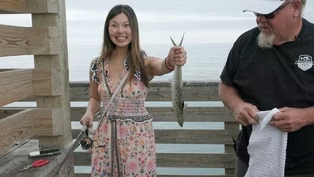
[music] - For more coastal fun, you can go fishing off Oceana Pier in Atlantic Beach.
[music] Oh, how fun!
[music] I love that sound.
[music] - As soon as I hook him up, I'm going to hand you the rod.
- Okay.
You trust me?
- Yeah.
[laughter] Then it's got one.
[laughter] - I'm a weak, weak person.
- That's a good fish.
Keep him coming.
Keep him coming.
Keep him coming.
[music] - Okay.
I did it.
[laughter] - He's a keeper.
[music] - After fishing, lunch is steps away at the Oceanana Pier House Restaurant, where we had fresh ceviche, smoked fish dip, a chuleta kan kan pork chop, and a fried soft-shell crab sandwich.
[music] There's plenty of good eating and good fun to be had at the Crystal Coast this summer.
[music] - Seashore Oyster Company offers guided oyster farm tours on North Carolina's Crystal Coast.
Tours depart from 229 Willett Drive in Beaufort.
The Oceanana Pier House Restaurant is located at 700 East Fort Macon Road in Atlantic Beach.
For current hours and menu information, visit oceananapier.com.
Next, we're heading high into the mountains of Madison County, where a walk in the woods becomes a meal you'll never forget.
Join us for a unique experience that celebrates the flavors, traditions, and natural beauty of Appalachia.
[music] - The woods are my home.
I feel more myself in the woods than anywhere else.
[music] This particular cove, Shelton Laurel, in Madison County, Western North Carolina, is a place where ballad singers settled many generations ago.
It's a place that is rich in musical heritage and folk song.
[music] We grew everything we ate.
We went to town twice a year.
We needed nothing else.
Ramp season, my favorite time of the year.
They're green, they're pungent, they're astringent, they're spicy, they're hot, they're wild.
Wow.
Mmm.
Can't get any better than that.
I feel selfish enjoying all this bounty on my own, so I enjoy sharing that.
The Appalachian Culinary Experience takes place on this mountainside halfway up the Sugarloaf at about 3,000 feet.
It is a combination of ingredients, cooking, entertaining, savoring moments around the table.
- Susi has special knowledge.
- (Susi off microphone) ...from four different heirloom varieties of apples.
- She's written several books, and she's a French chef.
If you really want to experience Appalachia, I can't think of any better way to do it than with Susi.
[music] - Walking in the mountains, drinking water from a fresh spring, learning from Susi, meeting her parents, it's a complete joy.
- All of the walks are adaptable.
I can adjust the path that we might take.
Morels need you to believe in them in order to find them.
Look at that.
There you are.
OK.
[music] You can take a sniff.
It is really, really delicate and lovely at the same time.
[music] We're going to start with a tomato tart with thyme and clière and, of course, ramps, because we have ramps at our fingertips.
Aren't we lucky?
Press rather than push, because you don't want to tear the dough.
- The food experience, it's sensory.
It is the noises.
It's the smells.
It's the movements.
All of it is combined in such a delightful way.
[music] - To wonderful weekends with friends, wandering the fields and the hollers, which is my very favorite thing to do, and to everybody being willing to try branch lettuce and sochin and ramps and morels and all the wonderful things that grace our table tonight.
[music] - I am a meat and potatoes kind of guy.
Susie has expanded my palate.
[music] - When you have a steak, you know, you've had these things before.
But then adding these components, these elements that are unique to the place where you are, just deepens that experience.
It makes that steak so much better in so many ways.
And having watched it be prepared, having your hands in it yourself, being a part of that process, all of it is so incredible to the experience.
[music] ♪♪ - The Appalachian Culinary Experience is hosted the last Saturday of each month from March until October.
For more information, visit AppalachianCulinary.com.
As America marks its 250th anniversary, we're exploring places across North Carolina where history still comes alive.
This week, our journey takes us to Charlotte, where monuments, historic sites, and a self-guided Liberty Walk reveal how the Revolutionary War unfolded right here on city streets.
Lucas Pruitt takes us there.
- This is the McIntyre Historic Site in Charlotte, North Carolina.
It might not look like much today, but in 1780, it was a proving ground for local resistance against a British occupation.
After a disastrous defeat at the Battle of Camden, Patriot forces were on the run, and General Cornwallis decided to chase them right into North Carolina.
But the local residents of Mecklenburg County were not having it.
According to local tradition, while British and Loyalists were out foraging and plundering McIntyre's farm, Patriot riflemen from the surrounding neighborhoods stalked them from the treeline.
But when the Patriots opened fire, the British couldn't see who was attacking.
They feared they were outnumbered and retreated.
Patriots continued to harass the British troops daily.
So on October 12th, Cornwallis left Charlotte in a hurry, purportedly calling it a "hornet's nest."
The name stuck.
Today, this park commemorates the Battle of McIntyre's farm.
Excavations are ongoing, and new interpretive signage will soon tell its story.
- What's so significant about this location today is that it's the only battlefield in Mecklenburg County that you can step foot on.
It's the only battlefield that isn't under a skyscraper.
- There's a hope we can bring more attention and awareness to the fact that the site exists, and that we may be one of the turning points of the war, which we seldom get credit for.
- Just down the road, the Charlotte Liberty Walk has even more stories to tell.
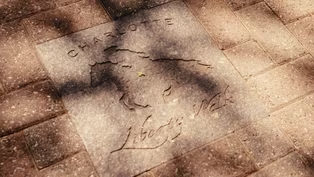
A free, self-guided multimedia experience, the walk features 19 markers, the site of the British encampment, the courthouse where Cornwallis's cavalry was repulsed, the Mecklenburg Resolves.
Each marker connects to audio content full of history and hidden details for you to explore.
It helps you imagine what these iconic downtown locations might have been like during the founding of our nation.
- The Charlotte Liberty Walk gives people this opportunity to learn about our revolutionary past.
Most people come to Charlotte, and they see these brand new buildings everywhere, and they have no idea that Charlotte and Mecklenburg County were deeply involved in the Revolutionary War.
We have several videos that talk about the history of not just the markers and monuments that we have here on the Charlotte Liberty Walk, but also the history in general of Mecklenburg County from before the war through the end of the war.
We are at marker 13 on the Charlotte Liberty Walk.
This is the oldest cemetery in Charlotte.
It's actually called Old Settler Cemetery.
So many of our Revolutionary War patriots are buried here.
And just a bit behind me, you can see the square corner of Trade and Tryon.
That's actually where the courthouse was where a lot of the fighting during the Battle of Charlotte took place.
This site that we're standing on right now was used as a British hospital.
In fact, British were buried here in this location.
It's so important to note that history happened here.
And even though you can't see it, it's buried under a building.
Our history matters so much.
And so it's really important that we let people know that this experience is here.
- The Charlotte Liberty Walk is a self-guided tour.
To learn more and plan your visit, go to charlottelibertywalk.com.
That's it for tonight's show.
Summer is a great time to get out and explore our state.
And we hope we've shown you a few destinations worth discovering.
If you've missed anything in tonight's show, you can watch us again online at pbsnc.org, or you can find all of our stories on our YouTube channel.
Have a great North Carolina weekend, everyone.
(upbeat music) ♪ ♪ - Funding for "North Carolina Weekend" is provided in part by VisitNC, dedicated to highlighting our state's natural scenic beauty, unique history, and diverse cultural attractions.
From the Blue Ridge and the Great Smoky Mountains across the Piedmont to 300 miles of Barrier Island beaches, you're invited to experience all the adventure and charm our state has to offer.
- This program is made possible in part by generous support from the American Battlefield Trust, connecting you to the places where our nation was forged.
Visit battlefields.org today.
(upbeat music)
Video has Closed Captions
Clip: S23 Ep24 | 5m 2s | Search for hidden gems at Emerald Hollow Mine in Alexander County. (5m 2s)
Video has Closed Captions
Clip: S23 Ep24 | 4m 28s | Explore attractions at Grandfather Mountain, including a new interactive space for kids. (4m 28s)
McIntyre Historic Site & Charlotte Liberty Walk
Video has Closed Captions
Clip: S23 Ep24 | 3m 26s | A multimedia experience in Charlotte explores how the city became a hornet’s nest for the British. (3m 26s)

Video has Closed Captions
Preview: S23 Ep24 | 19s | Celebrate summer with cool escapes and warm weather fun statewide. (19s)
Video has Closed Captions
Clip: S23 Ep24 | 5m 24s | Explore oyster farming at Seashore Oyster Company, a family-run stop on the NC Oyster Trail. (5m 24s)
Providing Support for PBS.org
Learn Moreabout PBS online sponsorship












Support for PBS provided by:
North Carolina Weekend is a local public television program presented by PBS NC