
Jouberts reflect on 40 years of African wildlife photography
Clip: 12/13/2025 | 10m 49sVideo has Closed Captions
Beverly and Dereck Joubert reflect on 40 years of African wildlife photography in new book
For more than 40 years, Beverly and Dereck Joubert have lived with, photographed and filmed African wildlife. Their images bear witness not just to the majesty of life on the continent, but also the host of threats that confront both the animals and the wilderness. John Yang speaks with the Jouberts about their new book, “Wild Eye: A Life in Photographs,” and their decades of work.
Problems playing video? | Closed Captioning Feedback
Problems playing video? | Closed Captioning Feedback
Major corporate funding for the PBS News Hour is provided by BDO, BNSF, Consumer Cellular, American Cruise Lines, and Raymond James. Funding for the PBS NewsHour Weekend is provided by...
Jouberts reflect on 40 years of African wildlife photography
Clip: 12/13/2025 | 10m 49sVideo has Closed Captions
For more than 40 years, Beverly and Dereck Joubert have lived with, photographed and filmed African wildlife. Their images bear witness not just to the majesty of life on the continent, but also the host of threats that confront both the animals and the wilderness. John Yang speaks with the Jouberts about their new book, “Wild Eye: A Life in Photographs,” and their decades of work.
Problems playing video? | Closed Captioning Feedback
How to Watch PBS News Hour
PBS News Hour is available to stream on pbs.org and the free PBS App, available on iPhone, Apple TV, Android TV, Android smartphones, Amazon Fire TV, Amazon Fire Tablet, Roku, Samsung Smart TV, and Vizio.
Providing Support for PBS.org
Learn Moreabout PBS online sponsorshipJOHN YANG: For more than 40 years, Beverly and Derek Joubert have lived with, photographed and filmed African wildlife.
The images they captured are beautiful, savage, haunting and mesmerizing.
They bear witness not just to the majesty of life on the African continent, but also to the host of threats, many of them man made, that confront both the animals and the wilderness.
They have a new book entitled "Wild Eye: A Life in Photographs."
It winnows down four decades of work to about 250 of the most powerful photos.
Earlier, I spoke with the Jouberts, photographer and conservationist Beverly and filmmaker Dereck.
I asked them why they published a retrospective now.
BEVERYLY JOUBERT, Award-winning Photographer and Filmmaker: It's really important to be able to look back and see what life was for us then and for, you know, all the animals and where we are today.
And, of course, we are losing at an alarming rate everything from the cats to elephants and landscape.
So we thought if we could bring a piece together that truly is celebrating these animals and hope that everybody will want to try and protect them.
DERECK JOUBERT, Award-winning Photographer and Filmmaker: I think that's true.
You know, I think that it's a time now for us to all reflect on what was and then determine what's going to be.
JOHN YANG: What are the threats that you see?
DERECK JOUBERT: Well, we've seen quite a lot of poaching threat.
We've seen over hunting in a lot of places.
It seems like Africa more and more is becoming this forgotten place that people are so involved in their lives in the rest of the world that the future of wildlife is off the agenda.
JOHN YANG: How did you decide?
How did you pick which images went into the book?
BEVERLY JOUBERT: That was a challenge.
I can tell you, going through 40 years of photography, the image really needed to tell a story.
Some of the images are a little harder to look at, but they are telling a powerful story.
And so that's how, you know, we selected.
Not every image will go on a wall, but they're important to be able to tell the story of Africa's wildlife.
DERECK JOUBERT: I also think that some of the storytelling that was chosen through these images spoke more about moments before the image was taken and what's going to happen after the image was taken.
So these are not just snapshots in town.
These are indicators or reflections of a story that's going on there, and so draw the audience of the viewer in.
JOHN YANG: Let's talk a little bit about that by looking at some of the pictures.
First, there's a leopard in a baobab tree.
And in the book, in the caption, you've given this leopard a name.
Do you often do that with the animals you photograph?
BEVERLY JOUBERT: When we're out there, you know, we'll spend two to three years with the animals that we're filming.
So, yes, we do if we get to know animal.
This particular leopard we got to know very well because it was the mother to a little leopard that we stayed with for four years.
And the little leopard we stayed with for four years is the front cover of the book "Wild Eye."
DERECK JOUBERT: And I think there are a couple of more functions of actually naming these things.
We give them characters, or rather we reveal their characters.
If it's just, you know, leopard number F125, there's no characterization there.
But these are real personalities, and I think that we do them a disservice by not at least giving them a fair shot at winning your heart.
BEVERLY JOUBERT: One of the important about her up in that baobab tree is more than 2,000 years old.
So it's not only about protecting her as one of the cat species, but it's by protecting the land so you can protect everything else, all the biodiversity and the fauna and flora.
JOHN YANG: The next photo is of a lion cub, and it really is sort of almost a star photo.
You've got that rainbow perfectly placed behind this cub.
Talk about that, about how you get the right image, you want frame it.
And also just that getting it from.
BEVERLY JOUBERT: The right perspective, it's always a challenge to get the right image.
I mean, I take thousands of images that would never be perfect in my eyes or in Derek's eyes, but this particular one line was observing the rest of the pride.
And so it meant that we could move around, and as we moved around with our vehicle, we could position the rainbow exactly behind this little one.
DERECK JOUBERT: Of course, there's some tension within this image because while the rainbow is perfectly positioned for Beverly's lens position, perfectly for mine.
And so there's dialogue in the vehicle is, can you go forward about two feet?
I'm going, no, why would I do that?
JOHN YANG: You're the filmmaker there.
DERECK JOUBERT: Exactly.
And so we've always got to weigh that up and balance that and our lives.
BEVERLY JOUBERT: Yeah.
JOHN YANG: Then the next photo is of lions in trees.
And you say it's unusual to find lions in trees.
BEVERLY JOUBERT: It is.
Some areas the lions have started adapting and going up trees.
But the problem is not like a leopard.
They can't go straight up a tree trunk.
They can't lock their ankles like a leopard can.
So it's a challenge for them.
So this was a beautiful reclining tree, so it was easy for them to get up.
JOHN YANG: I've heard both of you say that you're big cat people.
Talk about that.
DERECK JOUBERT: Well, Beverly has a wild side to her.
No, we -- when we came out of university, our very first assignment out there, even though were researchers then, was studying lions and so that got into our DNA and we studied lions for 35 years.
Somewhere along the line we found cameras and we started photographing and filming them as well.
And we just keep coming back because that's where we feel most imbalance, I guess.
BEVERLY JOUBERT: Yeah.
And you know, over a 60 year period, they've declined by 95 percent And that's all the big cats.
And so leopards have this beautiful skin and we need to speak out for them because everybody know would like to acquire one of their skins.
And with so few left in Africa, we feel like we need to be the ambassadors.
JOHN YANG: And of course, you don't just photograph big cats, you also photograph other animals.
We've got these zebras in the book.
You say these zebras are actually going someplace.
BEVERLY JOUBERT: These zebras, I mean, it's quite an unusual situation.
So when the rains come, they go to one of the harshest places, which is a salt pan called the Makgadikgadi Pans.
And they're going there because they need minerals.
So as the rains come and all the pans fill up, they go there, they spend a couple of months there, they build their bodies with all the minerals and then they come back.
So they are migrating in that image.
DERECK JOUBERT: And I think an image like this is exactly what I was talking about earlier on, John.
It talks about who.
So these zebras are in or what and in what landscape?
So the stalks of the reeds in the perfect habitat for them because it matches and speaks to architecturally what a zebra is.
And then what next?
Why would they be wading through the water to go to water?
And I think the best photographs end with a question mark.
JOHN YANG: Not just the beauty, but also some of the violence of life in Africa.
A photograph of a lion battle with an elephant and then you also capture the kill.
And you said that this kill took days because the elephant is so large.
I mean, I find this image difficult to look at.
But what was it to watch that, to be there while that was going on?
BEVERLY JOUBERT: So the first image, that is a female cow.
And that happened at 2 in the morning.
So that is a challenge, you know, on its own.
I remember shouting out to Dereck, he had to wake up and start filming.
And I start, you know, taking the photographs.
And she was about 21 years old.
Nine lions in the pride.
And it was opportunistic.
They were the first to ever capture lions trying to bring down an elephant.
And this particular image was a story of hope for us because she fought for her life for at least a half an hour and she did get away.
DERECK JOUBERT: So these two images together play light and dark.
They play hope and desperation and despair.
And so the female that Beverly's talking about did actually get up and run off.
She had a will to live.
And this older bull in this image gave up hope.
And that was a long, grueling couple of days for us to sit and film and photograph through.
But the way that we get through that is we fortify ourselves with the knowledge that we didn't play a role in this.
We're silent observers within this.
And this is going on up and down through Africa behind us one way or the other.
We can't intervene.
We can't change that destiny for these animals.
But what we can do is use our tools, our cameras, to bring that to audiences so there's a better understanding of the facets and nuances of nature.
Otherwise we go down self-generating sense that everything out there is Disneyland.
And I think it's good for people to know that there's a harsh side to Africa as well.
JOHN YANG: You've been at this 40 years, hundreds of photographs in this book.
Is there an image you're still chasing, an image you want to capture that you haven't yet?
BEVERLY JOUBERT: There's always an image I'm still chasing.
I don't quite know what it is because I need to be open to, you know, whatever comes our way.
But the images definitely need to be preserving and protecting wildlife in Africa.
DERECK JOUBERT: And I think that's the journey, isn't it?
Is not necessarily caring about where you're going to end up, but being open to the steps along the journey as they present themselves to you.
BEVERLY JOUBERT: Yeah.
JOHN YANG: Dereck and Beverly Joubert, thank you very much.
Just amazing pictures.
Thank you very, very much.
BEVERLY JOUBERT: Thank you, John.
DERECK JOUBERT: Thank you.
BEVERLY JOUBERT: Really appreciate.
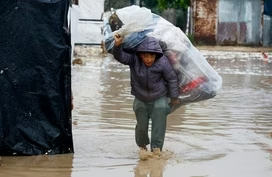
Displaced Gazans face dire conditions months after ceasefire
Video has Closed Captions
Clip: 12/13/2025 | 6m 5s | Displaced Palestinians struggle with cold, malnutrition in Gaza months after ceasefire (6m 5s)

How tariffs are making the holidays less merry for shoppers
Video has Closed Captions
Clip: 12/13/2025 | 3m 55s | How tariffs on China are making the holiday season less merry for shoppers (3m 55s)

News Wrap: Trump vows retaliation for U.S. deaths in Syria
Video has Closed Captions
Clip: 12/13/2025 | 3m 1s | News Wrap: Trump vows retaliation for killing of Americans in Syria (3m 1s)
Providing Support for PBS.org
Learn Moreabout PBS online sponsorship
- News and Public Affairs

FRONTLINE is investigative journalism that questions, explains and changes our world.

- News and Public Affairs

Amanpour and Company features conversations with leaders and decision makers.










Support for PBS provided by:
Major corporate funding for the PBS News Hour is provided by BDO, BNSF, Consumer Cellular, American Cruise Lines, and Raymond James. Funding for the PBS NewsHour Weekend is provided by...