
You Can't Make This Up
Season 10 Episode 2 | 26m 24sVideo has Closed Captions
Real life can be stranger than fiction.
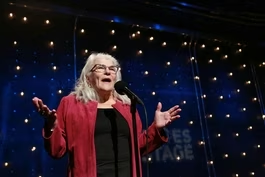
Real life can be stranger than fiction. Jameer Pond’s embarrassing confrontation with Travis Scott earns him a place in hip-hop history; Susan Rohde searches for a bomb at the luxury hotel where she works; and Adam Linn, who is blind, discovers a new sense of freedom driving across the Golden Gate Bridge. Three storytellers, three interpretations of YOU CAN’T MAKE THIS UP. Hosted by Wes Hazard.
Problems playing video? | Closed Captioning Feedback
Problems playing video? | Closed Captioning Feedback
Stories from the Stage is a collaboration of WORLD and GBH.
You Can't Make This Up
Season 10 Episode 2 | 26m 24sVideo has Closed Captions
Real life can be stranger than fiction. Jameer Pond’s embarrassing confrontation with Travis Scott earns him a place in hip-hop history; Susan Rohde searches for a bomb at the luxury hotel where she works; and Adam Linn, who is blind, discovers a new sense of freedom driving across the Golden Gate Bridge. Three storytellers, three interpretations of YOU CAN’T MAKE THIS UP. Hosted by Wes Hazard.
Problems playing video? | Closed Captioning Feedback
Where to Watch Stories from the Stage
Stories from the Stage is available to stream on pbs.org and the PBS app.
Providing Support for PBS.org
Learn Moreabout PBS online sponsorshipJAMEER POND: Just as our altercation got to a feverish pitch, I felt a real firm hand on my forearm, and I knew I did not want to pop off with him.
SUSAN ROHDE: If somebody told me to get out of bed and go to a building that might blow up, I would say, "No, thank you."
ADAM LINN: Windows were wide open.
I could feel that cold wind blowing through my hair.
This is the taste of freedom.
WES HAZARD: Tonight's theme is "You Can't Make This Up."
Some stories are so wild, so perfectly timed, so absurdly human that they sound made up.
Whether it was a coincidence that you just can't account for or misunderstanding that spiraled out of control, or some wild circumstance in your life that no Hollywood screenwriter would even dare attempt.
Tonight's tellers are gonna share experiences that show us that sometimes, real life is stranger than fiction.
POND: My name is Jameer Pond.
I am from Brooklyn, New York, and I am a live storyteller, an actor, and an interviewer and director.
Did you have storytelling as part of your life growing up?
Were there people in your family who were storytellers?
Like, what was your idea of storytelling?
I just knew it as, "Oh, my uncle is telling, like, this story."
I didn't know about it as an art form until about, like, 2021, and I took a storytelling class.
And that's when, like, my, my world opened up to storytelling.
But I had no idea.
And what would you say that you've learned about yourself from storytelling?
It's that, like, vulnerability is a superpower.
Cause what I've learned is that me sharing my story allows other people to be comfortable enough to be like, "You know what, man?
I wasn't gonna say anything, but I had the same experience."
And that shared kind of commonality is, I think, what connects all of us.
Race, color, creed, gender.
We all are comprised of stories.
And so me being able to tell my story like that allows people to tell their story.
When I was a kid, I would be in the back of my mother's black Mitsubishi Galant driving through the streets of Brooklyn, New York, begging for three minutes of radio time so that I could hear rap music on HOT 97.
Now, my mother was an elementary school principal.
She did not like a lot of noise in the morning.
This was a smooth jazz vehicle, eh?
She would always say no.
And so I would have an attitude in the back seat, because at seven years old, I had a true hatred for Kenny G.
(laughter) Kenny G did not keep the bullies away.
And when you were shorter than everybody in your class with a lisp and big glasses, the bullies were always present.
But when I Would listen to people like 50 Cent and DMX and Lil' Kim-- like, they were superheroes to me.
And their Hall of Justice was HOT 97.
And I used to listen to these interviews that these radio personalities would do with these artists, and it ingrained them in hip-hop history for me.
And I thought that was so cool.
I said, "That's what I want to do.
"I want to be ingrained in hip-hop history.
I want to be a radio personality."
And so I would pray in that backseat of that black Mitsubishi Galant that one day it would come true.
Well, 20 years later, if you could believe it, I got a job working at HOT 97.
(cheering) Yeah.
(cheers and applause) Not as a radio personality.
(laughter) Oh, no.
But as a part-time videographer.
I hated it.
Because in my mind, I'm a star, right?
(laughter) I couldn't fathom of being behind the camera.
But working at HOT 97 had its perks.
I mean, I got to see all of my favorite radio personalities every day.
I met every hip-hop hero that I wanted to meet.
But the biggest perk for me was Summer Jam.
At the time, it was one of the biggest hip-hop festivals in the country.
Over 30,000 people packed into New Jersey's MetLife Stadium.
Millions of people streaming all over the world.
And in 2015, I got a chance to work Summer Jam.
And my manager gave me a camera, a monopod, and an all-access pass.
And as I'm walking up the back stairs to the stage, I stand there right by the DJ booth, and I look up, and I'm in awe.
It's thousands of people cheering and anticipating their favorite artists to come on stage.
And I'll be honest, I fantasized about this moment.
(laughter) I wanted to be the radio personality who grabbed the mic and would just cheer and people would go, (chanting): "Aah!
Ja-meer!
Ja-meer!
Ja-meer!"
(laughter) Thousands of people yelling my name.
And even though that moment wasn't for me, it still felt very purposeful.
And out of nowhere, like a dash of lightning, from the back of the stage to the front of the stage, ran this guy.
No shirt, tattoos, braids in his hair.
He grabbed the mic, he held his hand up, and he said, "I'm Travis Scott, and welcome to the rodeo."
And the crowd erupted like a powder keg.
Now, in 2015, I, much like a lot of you in here, had no idea who Travis Scott was.
(laughter) But-- I knew I'd be a fool if I didn't capture this.
So I grabbed my camera-- and I'll be honest, I was excited.
I had just learned slo-mo.
(laughter) And so Travis is running around the stage, and I'm just capturing him, I'm not letting him out of my sight.
Standing stationary by the DJ booth.
Four songs go by.
Travis grabs the mic, he signals to his DJ to cut the music.
And then he turns around and says, "Hey, yo, get this nerd off the stage, bro."
(laughter) Now, as I stand there with my camera in one hand, my monopod in the next, and my big reading glasses, I started looking around like, "Who's the nerd that's interrupting... (laughter) ...this show?"
But as he started marching towards me and pointing in my direction, I quickly realized that I'm the nerd that he's talking about.
So now his team is pulling me off the stage.
I'm holding my all-access pass in the air, cause maybe they didn't see it.
(laughter) So we standing right by the stage now.
And he says on the mic, "I don't care where you work.
This is my show.
This is my stage.
Get off."
And people started laughing.
And I was instantly transported back to seven-year-old Jameer in third grade, when I had all the bullies.
But I knew on hip-hop's biggest stage, I wasn't gonna go out like that.
I'm not soft.
So I squared my shoulders back and I planted my monopod on the ground like a staff.
(laughter) And I looked at him in his eye and I said, "You want to pop off?"
(laughter) Just as our altercation got to a feverish pitch, I felt a real firm hand on my forearm, and I like looked to the left and I had to look up all the way... This dude was like 8'12".
It was his security guard.
And I knew I did not want to pop off with him.
(laughter) And he led me down the stairs from which I came.
And I'm embarrassed now, because what had happened in front of thousands of people in attendance started to spread like wildfire all over social media to millions.
Two months later, one of my co-workers stopped me and goes, "Jameer, before you leave, I think you should know, Travis Scott just dropped a diss song about you."
So I take my bag off and I listen to this song called "Antidote" by Travis Scott.
And I'm listening to the song and the lyrics towards the end go, "kicking the cameraman off of my stages cause I don't like the way he's taking my angles."
Instantly, I get enraged, because, one-- you did not see the masterpiece that I was creating on that stage.
(laughter) In my mind, they were calling me young Spike Lee, okay?
(laughter) But secondly, and most importantly, I was enraged because the song was fire.
It was a great song.
It's hard to be mad up top when you tapping your foot on the bottom.
(laughter) I knew it was gonna be a hit, and I was right.
It sent Travis Scott's career out of the stratosphere.
Keep in mind, I had to work at a radio station.
I had to hear this song, at its peak, nine to 12 times a day.
(laughter) He became a household name.
And I chose to work on forgiveness.
While in therapy one time, pouring out my emotions, I realized that seven-year-old Jameer manifested this whole thing in the back of his mother's black Mitsubishi Galant.
I told myself I wanted to work at HOT 97.
I told myself I wanted to be known by thousands of people across the world.
(laughter) I told myself I wanted to be ingrained in hip-hop history, and well... (laughter) If I could leave you all with anything: Dream big!
But be specific.
(laughter) Thank you.
(cheers and applause) ROHDE: My name is Susan Rohde.
I live just outside of Chicago.
I work in higher education, and my husband and I have been foster parents for 26 years.
I'm curious, what led you to want to open up your home in that way?
My parents always had foster kids and my husband and I didn't have our own kids, so it just made sense.
And what is something that, you know, that experience over all these years has taught you?
Kids are fine, they're amazingly resilient, and I'm always in awe of how well they have come through wherever they are in their life.
And what do you like about working in higher education?
I work at a community college, so it's like getting a chance to make a difference in someone's life every day.
Just seeing them and enjoying that energy is a lot of fun.
HAZARD: You help run a storytelling show of your own, and I'm wondering, what do you like about helping to create that space for other storytellers to share?
I think storytelling is so important for building community.
A neighbor you may never know, you go to storytelling and you learn a little bit about them that might bring you closer.
It's really not a lot of effort and there's a lot of reward.
So I was 26 years old, and I was the food and beverage director in Chicago at a luxury all-suite hotel in the Gold Coast.
I was living in a condo building in Lincoln Park, not far off the lake.
Quite honestly, I had it all... Except an air conditioner.
(laughter) And that summer was so hot... I broke down and I bought one.
And on the day it was installed, I left work early, and I turned the temperature as low as it would go and I turned the fan as high as it would go.
And within minutes, I could see my breath in my bedroom, and I shut the light off, and I jumped under the blankets, and I was asleep in no time.
And then the phone rang.
It was somebody from the hotel telling me I needed to come into work.
There was a bomb threat called in, and everybody, director-level and up, had to report immediately.
I said, "I'll be right there."
Now, I'm 67 years old.
If somebody called and told me to get out of bed and go to a building that might blow up... (laughter) ...I would say, "No, thank you."
(laughter) Why did I go in then?
It would take years of therapy to understand.
But I did.
And I said to the general manager, "What do you want me to do?"
And he's like, "Well, go look for the bomb."
(laughter) "O-okay, well, what does it look like?"
(laughter) He said, "Just look for anything unusual."
And he sent me up to the kitchen, since that's where I normally worked.
Well, if you have ever been in a commercial kitchen, everything is unusual.
It's stainless steel and cold, and there's always this light smell of gas in the air.
But there was nothing unusual.
So I went downstairs and reported that.
And he said, "Well, then go check the offices."
The first six floors of this hotel were private offices.
So I took the elevator up to the fourth floor, and as soon as the door opened, there was an Igloo cooler with a lock on it.
If I were going to bring a bomb into a luxury hotel, I would put it in an Igloo cooler.
(laughter) I was almost excited that I found the bomb.
I ran downstairs, I told the general manager, and he set me back up with somebody from the bomb squad.
He did not accompany us.
(laughter) So I go up there with the bomb squad guy who looks at it.
He picks it up, and he's like... (laughter) "That's not a bomb!"
It was blood samples from the doctor's office, probably all broken in the cooler, but that's a different story.
So now it's coming up on midnight, and the bomb is supposed to go off at 2:00 in the morning.
And I'm starting to get a little nervous.
And they finally decide to evacuate the hotel.
So all of us were given different tasks.
A whole bunch of people got to sit in the lobby and call the rooms and say, "We need you to evacuate.
There's nothing to worry about, but don't take the elevator."
(laughter) My very favorite was the director of sales, who stood in the lobby, and as people came downstairs, they're in their pajamas.
They are so crabby and angry.
(laughing): And she would... she would say, "I apologize for the inconvenience.
"We are bringing you to our sister hotel, "a lovely property east of Michigan Avenue with the same amenities you enjoy here."
And I'm like, "God damn!
The building is gonna blow up!"
(laughter) Now, my job-- and this makes me think they had a new food and beverage director in the wings-- my job... (laughter, scattered applause) ...was to go to the top floor, 28 floors, and knock on the doors in case somebody didn't get the phone call.
(audience groans) I know.
So, there's six suites per floor.
I'd go to one door.
Knock, knock, knock, knock.
Next door-- knock, knock, knock, knock, knock, knock, knock, knock.
All six at one time.
If nobody answered, I ran down the stairs to the next floor.
Knock, knock, knock, knock, knock, knock, knock, knock-- fast as I could, down the stairs again.
I can't even tell you how scared I was.
Knock, knock, knock, knock, knock, knock, knock, knock.
I knocked on the door, and one guy answered.
I was as startled as he was.
I think he had been drinking since Tuesday and I just woke him up.
(laughter) I said, "Sir, I need you to evacuate."
"Ejaculate?!
What are you talking about?"
(laughter) In the end, there was no bomb.
There never was a bomb.
So now I had two choices.
I could go home to my extraordinarily cold bedroom, or I could go out drinking with everyone else, and laugh about tonight.
I went out with all my friends... because I didn't have to get up in the morning.
All of the guests were at a sister property east of Michigan Avenue.
Thank you.
(cheers and applause) LINN: My name is Adam Linn.
I'm from Dorchester, which is a neighborhood of Boston.
I live in Manhattan now.
I'm a comedian, writer, storyteller.
Been doing this for many, many years.
I'm really excited to be here.
When our audience hears your story, what would you most hope that they take away from that experience?
I love it when I surprise an audience, when they see me and they say, "Oh, you know, here's this blind guy.
He's going to tell us about a certain thing," and then the story takes a 90-degree turn and it's completely different.
I want you to see that I have a really interesting internal life, that I have an interesting family dynamic.
I hope that people find the story fun, but I hope they also walk away and, like, see me as a person, rather than just an idea.
Being unable to see the audience, how do you-- does that-- do you feel that affects your perception when you're up on stage?
How do you manage that?
Is it something that you think about?
LINN: Definitely.
You can't see the audience, but I can certainly feel them.
You can hear them.
I love to hear the rustling in the chairs, the creaking of the jackets, the pocketbooks.
You have that moment in the room where you're trying to build something between you and them, and that's very special.
I'm from Boston.
I grew up in Dorchester.
I was a sickly kid.
A lot of doctors.
We're talking Bay State Bubble Boy here.
(laughter) And... as an only child with a single mom, my health problems caused us a lot of stress.
Then when I turned 12, my vision started to fade and I ended up going blind.
Total darkness.
Now, my mom and I handled this in different ways.
I got angry, and she went nuts.
(laughter) Basically, she worried about me all the time.
I remember one night, I was up in my room.
She's downstairs, watching Magnum P.I., having a glass of wine.
And I could hear that she was crying.
I hate crying!
Especially when it's about me.
I stomped downstairs.
Before I could say anything, my mother got off the couch.
She puts her arms around me.
"Adam, I love you.
"But I'm so afraid the world "will not see you the way I see you.
"But don't worry.
"You'll always have a place here with me.
You'll be safe."
And at this point, she's grabbing me like an octopus.
(laughter) I push her away.
Because at this point, all I wanted was one thing: freedom.
I said, "When I grow up, "Mom, I'm going to, to...
California!"
That was the furthest place I could think of.
(laughter) My mother acted like I'd hit her.
"California?
You're going to move to California?
"Do you know what will happen to you "if you move to California?
"I'll tell you.
"You will join a cult, "you will get hooked... "on heroin, and then you will jump off the Golden Gate Bridge."
(laughter) So how was I going to get to California?
Well, I would study really hard.
So I ended up at this competitive high school where I was the only kid with a disability.
And all of my mother's irrational fears about how the world would treat me, they all came true.
(laughter) The teachers did not want me, I had a really hard time making friends.
Girlfriends?
Not a chance.
It got to the point where all the kids were getting driver's licenses, and I felt so left behind.
The prom was coming up and I said, "Well, I definitely won't be going to that."
But then, minor miracle.
My friend Tim, kid I'd grown up with in the neighborhood, really popular class clown.
He convinced one of his extra girlfriends... (laughter) ...to take me.
And that's how I ended up at the best after party of all times.
Plenty of weed, wine coolers, and me, behind the wheel of Tim's '72 Barracuda, doing donuts in the Tenean Beach parking lot.
Now, blind driving may seem like a really bad idea, but Tim's father was a Boston cop.
So, short of murder, we could do whatever we wanted, basically.
Yeah.
(laughter) After high school, I went off to college.
Tim went off to the police academy.
We lost touch.
But I never lost my California dream.
So as soon as it came time to send out resumes, I sent 100 resumes out there.
And I got one... one nibble.
It was from a big bank in San Francisco.
I was so happy, I flew out there.
I sat down at the interview, and right away, I knew... that I wasn't getting the job.
I went back to my apartment.
I was shattered.
I thought, "That's it.
I'm going to have to move back to Dorchester."
And when I was at my lowest, my phone rings.
And it's Tim, of all people, and he's out on the West Coast and he wants to see San Francisco.
And can he crash on my couch for a couple of nights?
Yeah, of course.
So Tim shows up, and he's his big, loud Boston self.
It was fantastic.
We went all around the city.
On our last night there, we're sitting in a bar, and I said, "Tim, I am going to be so sorry to see you go."
He said, "Ah, don't worry about it.
I'm going to be out here all the time."
I said, "Tim, don't you understand?
"I didn't get the job at the bank.
I'm going to move home."
And he got short with me.
He said, "Really?
You're going to move home?
"What, and live with your mother?
Are you crazy?
(laughter) Get another job.
You're already out here."
And I wanted to strangle him.
He made it sound like it was so easy.
And he said to me, "Adam, I would do anything "to live out here in (emphasizing): San Fran-cis-co."
It was the '90s, and we were Irish Catholic.
So when you said (emphasizing): "San Fran-cis-co," that meant gay.
I said, "Tim, you're gay?"
He's like, "Yeah, I guess so."
And I was like, "This is wonderful.
"Come, move out here.
We'll be roommates.
It'll be great."
He said, "Really, Adam?
"You think it's that easy?
"Let me explain.
I am a Boston cop.
"My father is a Boston cop.
"My freaking sister is a Boston cop, okay?
"I can't just move to (emphasizing): San Fran-cis-co."
(laughter) Finally, Tim said, "Look, we're not going to "solve the world's problems tonight.
"Let's go out to the beach in the parking lot and I'll let you do a little driving."
I said, "You know what, Tim?
"I've done the beach parking lot.
"How about I do you one better?
"What about I drive us around the city "and then I get us over to Marin?
"Because before I move home to Dorchester, "I want to know what it feels like to drive a car over the Golden Gate Bridge."
(laughter) So, Tim stands up, drops the keys on the bar and says, "Eh... oh, what the hell?
It's a rental."
(laughter) Believe it or not, I started to lose my nerve.
I thought, "Okay, uh... this might be a tiny bit crazy."
(laughing): M-m-- you know... "Maybe I shouldn't drive over the Golden Gate Bridge."
Now, the problem was, at this point, Tim was really into it.
He said, "No, no, the problem's the music."
Off came Tony Bennett.
He put Tina Turner, "River Deep-- Mountain High," Phil Spector, 1966 version on.
We whooshed down the hill.
We hit the bridge doing about 60.
Windows were wide open.
I could feel that cold wind blowing through my hair, the creak of my leather jacket.
I could-- (inhales) smell the salt coming off the Bay.
It was like the entire atmosphere had become this enormous oyster that I could take in with every fiber of my being.
I thought, this is the taste... of freedom.
Got to the top of the bridge like a roller coaster, paused.
Tina Turner was howling.
The orchestra was thundering.
Whoosh, we went down the bridge.
Jug, jug, jug, jug-- We were over.
Oh, my God.
High fives.
I pulled over.
Hugs.
We had done it.
Next morning, I took Tim's advice to heart.
I made a few phone calls.
I got a job teaching computers to blind kids.
It didn't pay a lot, but it was enough to cover my bills and allowed me to stay in California.
A couple months later, my mom came out to visit.
Now, I was dying to stick the knife in and tell her this story.
Because, what is the point of rebelling against your overprotective mother if she doesn't know what you did?
(laughter) We're eating out at this restaurant.
I'm like, "Mom, Mom, Mom--" but she stopped me.
She said, "No, Adam, me first."
She said, "Adam, I just want to say "I am so proud of you, and I am sorry.
"I was fearful, and I tried to hold you back.
"You came out here, you got an apartment, you got a job.
"I look at you, sitting there-- "you are such a smart young man.
"You have such a good head on your shoulders.
(laughter) What were you gonna say to me?"
(laughter) I said, "Mom, um... "there's a lesbian bar called Blondie's "over in the Mission District that has 16-ounce martinis.
Do you want to go?"
"Yeah."
So she and I went out and got smashed.
(laughter) I have never told her this story until tonight, because she's sitting right there.
Thank you.
(cheers and applause) ♪ ♪
Video has Closed Captions
Preview: S10 Ep2 | 30s | Real life can be stranger than fiction. (30s)
Providing Support for PBS.org
Learn Moreabout PBS online sponsorship New Episode
 New Episode
- Arts and Music

Innovative musicians from every genre perform live in the longest-running music series.

 New Episode





 New Episode
 New Episode

Support for PBS provided by:
Stories from the Stage is a collaboration of WORLD and GBH.