Oregon Art Beat
Award-winning pianist Jim-Isaac Chua brings classical music to rural Oregon and SW Washington
Clip: Season 27 Episode 6 | 10m 6sVideo has Closed Captions
Award-winning pianist Jim-Isaac Chua brings classical music to rural Northwest.
For award-winning classical musician Jim-Isaac Chua, playing the piano is not just delivering a grand performance. But rather, a two-way conversation layered with sensitivity and nuance. The pianist makes it a point to tour rural Oregon and SW Washington so residents get an opportunity to catch a classical performance — for many, it’s their first.
Problems playing video? | Closed Captioning Feedback
Problems playing video? | Closed Captioning Feedback
Oregon Art Beat is a local public television program presented by OPB
Oregon Art Beat
Award-winning pianist Jim-Isaac Chua brings classical music to rural Oregon and SW Washington
Clip: Season 27 Episode 6 | 10m 6sVideo has Closed Captions
For award-winning classical musician Jim-Isaac Chua, playing the piano is not just delivering a grand performance. But rather, a two-way conversation layered with sensitivity and nuance. The pianist makes it a point to tour rural Oregon and SW Washington so residents get an opportunity to catch a classical performance — for many, it’s their first.
Problems playing video? | Closed Captioning Feedback
How to Watch Oregon Art Beat
Oregon Art Beat is available to stream on pbs.org and the free PBS App, available on iPhone, Apple TV, Android TV, Android smartphones, Amazon Fire TV, Amazon Fire Tablet, Roku, Samsung Smart TV, LG TV, and Vizio.
Providing Support for PBS.org
Learn Moreabout PBS online sponsorship(gentle piano music) - I try to communicate with every individual note, how can I create the sound, how can I create that emotion in such a way that people will feel that "Oh, I know what it is that the composer is trying to say?"
The piano, luckily, is a very sensitive instrument.
When you look inside the piano, you see so many different parts, so many different mechanisms inside, and that's fantastic because it's so sensitive to the performer.
My name is Jim-Isaac Chua, and I'm a classical pianist.
(serene piano music) My great-grandmother on my mother's side in the Philippines, to survive the Japanese occupation during the Second World War, she performed for the Japanese soldiers on the piano, and that's actually how they survived.
That kind of started a tradition in my mother's side of the family, where every generation people would learn to play piano.
(frenetic piano music) When you really love something, you just want to do it for the rest of your life, and that's what happened with me.
I started playing piano at the age of eight, and I just remember sitting in front of my piano teacher's CD player and just being in absolute awe.
(dramatic piano music) When I was 14, I wanted to get the shiniest shoes possible.
I just fell in love with music so much that I just wanted to look the part so much.
(lively piano music) (audience clapping) Growing up in Tri-Cities, Washington, I really feel that music has a place everywhere.
I feel like it has a place in a grand concert hall, and it also has a place in rural towns as well.
I just would love to give everyone the chance to be able to enjoy it, to be able to hear it, to be able to have their own experience of it.
(kids chattering) Hi, everyone.
(laughs) This isn't my normal hair, I just thought that I would dress up for you all too because... I think a lot of my passion and my desire to perform for young students comes from my own childhood.
(gentle piano music) We didn't have as many live concerts as I would've loved to attend.
And because of that, it sort of fueled a desire inside of me that there are many people who are just like me just waiting to hear this classical music.
(lively piano music) (music continues) (audience clapping) I will start with a waltz by Chopin.
Does anyone like to dance here?
(kids chattering) No dancing.
- Finding artists that want to come out to The Dalles is often difficult.
Having that opportunity for students, it gives them something to be like, "Hey, I could do that."
- Hi, I'm Abigail.
- [Jim-Issac] Oh, hi, Abigail.
- What inspired you to start playing piano?
- Yeah, I really have to thank my teachers because they showed me the really beautiful recordings and the really beautiful performances.
I think the really difficult thing with music, if you all really love music, is you have to be aware that there are some professions which are really unpredictable.
- Anything in the arts is kind of hard and a struggle, you know?
And he told the kids that, and the kids asking those questions, you know, it's amazing.
They were listening and they were paying attention to everything he said.
- I will tell you, though, that, when you do something which you really love to do, then, most of the time, you will find a way to live off of it because other people also want the same thing as well.
(audience clapping) (kids chattering) (frenetic piano music) (audience clapping) You know, classical music is very complex, but that's what makes it even more interesting for people to understand.
We have one note, this B-flat.
(piano resonating) It's like one word, right?
It's like saying, why?
Why, why, why?
Even this one-word question of why, it's so applicable to us nowadays.
You know, I think, even though Schubert was born in 1797, a lot of us are sometimes wondering in our lives, why?
And, you know, there's a lot of... Because we don't really have props, our job is to have the setting of the play take place in the listener's mind, like they are here with me on this beautiful journey, understanding and unraveling this composer.
(dramatic piano music) There are so many elements, which, as musicians, we have to be responsible for.
Tempo, rhythm, harmony, melody, balance, you know, pedal.
But when you remember the most important thing, then the audience also remembers.
What you hear as a performer is what the audience hears.
And that can be either really scary, or that can be really exciting.
Because if what you feel on stage is enthusiasm, excitement, you know, or let's say, sadness, you know, all these rich emotions, then the audience will feel it too.
(dramatic piano music continues) - The opportunity to be so close to someone with this kind of talent and energy, and is more like a gymnast than he is a pianist, it's just phenomenal.
(pensive piano music) (audience chattering) - No matter how many times you perform, it always feels like the first time.
(audience chattering) - [Announcer] It's my pleasure, my honor, to introduce my friend, Jim-Isaac Chua.
(audience clapping) - When we go on stage, we're basically completely naked.
We show everything.
We have to show everything.
Now, the question we should be asking ourselves today is, what does one have to experience in one's life to be able to create such touching music?
(piano music) Being a musician is not easy, but if I can be a positive light for this beautiful music and somehow fulfill someone's day, week, month, lifetime with this music, then that's so inspirational.
(audience clapping) (lively piano music) (no audio)
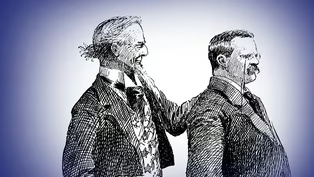 New
NewHomer Davenport and the Power of Political Cartoons
Video has Closed Captions
Clip: S27 Ep6 | 6m 40s | Political cartoonist Homer Davenport cut to the core of hypocrisy with a single image. (6m 40s)
Providing Support for PBS.org
Learn Moreabout PBS online sponsorship
- News and Public Affairs

Top journalists deliver compelling original analysis of the hour's headlines.














Support for PBS provided by:
Oregon Art Beat is a local public television program presented by OPB