
December 29, 2025
12/17/2025 | 55m 28sVideo has Closed Captions
David Wallace-Wells; Kristin Scott Thomas; Beth Macy
Author David Wallace-Wells discusses the state of global climate change. Actress Kristin Scott Thomas shares her new adventure -- directing "My Mother's Wedding," a deeply personal story based on her own life. Author Beth Macy introduces her new memoir "Paper Girl."
Problems playing video? | Closed Captioning Feedback
Problems playing video? | Closed Captioning Feedback
December 29, 2025
12/17/2025 | 55m 28sVideo has Closed Captions
Author David Wallace-Wells discusses the state of global climate change. Actress Kristin Scott Thomas shares her new adventure -- directing "My Mother's Wedding," a deeply personal story based on her own life. Author Beth Macy introduces her new memoir "Paper Girl."
Problems playing video? | Closed Captioning Feedback
How to Watch Amanpour and Company
Amanpour and Company is available to stream on pbs.org and the free PBS App, available on iPhone, Apple TV, Android TV, Android smartphones, Amazon Fire TV, Amazon Fire Tablet, Roku, Samsung Smart TV, and Vizio.
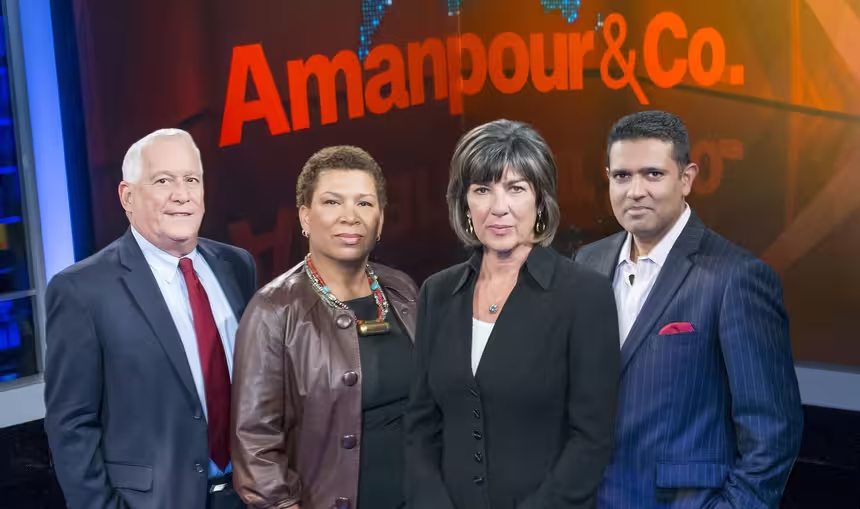
Watch Amanpour and Company on PBS
PBS and WNET, in collaboration with CNN, launched Amanpour and Company in September 2018. The series features wide-ranging, in-depth conversations with global thought leaders and cultural influencers on issues impacting the world each day, from politics, business, technology and arts, to science and sports.Providing Support for PBS.org
Learn Moreabout PBS online sponsorship(air whooshing) (upbeat music) - Hello, everyone, and welcome to Amanpour & Company.
Here's what's coming up.
From powerful storms to wildfires, the climate crisis is in full force.
I speak to David Wallace-Wells as the Trump administration brushes off science in a landmark appeal of fossil fuel regulation.
And... - It's incredibly exciting and it's obviously something I've never done before, so it's a huge adventure.
- [Christiane] Actress Kristin Scott Thomas on her directorial debut, "My Mother's Wedding," based loosely on her own life.
Plus... - Plus public schools, which are the foundation of our democracy, are in really rough shape.
- A portrait of poverty in America.
Journalist Beth Macy speaks to Walter Isaacson about "Paper Girl," her memoir documenting the decline of her Ohio hometown.
(upbeat music continues) (upbeat music continues) (upbeat music fades) - [Announcer 1] Amanpour & Company is made possible by the Anderson Family Endowment, Jim Atwood and Leslie Williams, Candace King Weir, the Sylvia A. and Simon B. Poyta Programming Endowment to Fight Antisemitism, the Family Foundation of Leila and Mickey Straus, the Filomen M. D'Agostino Foundation, the Peter G. Peterson and Joan Ganz Cooney Fund, Charles Rosenblum, Monique Schoen Warshaw, Koo and Patricia Yuen, committed to bridging cultural differences in our communities, Barbara Hope Zuckerberg, and by contributions to your PBS station from viewers like you.
Thank you.
- Welcome to the program, everyone.
I'm Christiane Amanpour in London.
From super typhoons battering Asia and destructive hurricanes plowing through the Americas, to major wildfires ripping across Europe, this year, the harsh reality of the climate crisis was felt all around the globe.
Coral reefs are now facing a widespread die off, the first in a series of ecological tipping points that signal a level of degradation close to the point of no return.
With nations failing to limit global warming to 1.5 degrees Celsius, the UN Secretary General has warned we must change course to prevent more devastating consequences.
And yet, the Trump administration has been rolling back on its climate mitigation plans in what's possibly the largest deregulatory action in US history, and it is pressuring other nations to do the same.
The Environmental Protection Agency announced in the summer that it would repeal the so-called endangerment finding, which says fossil fuels emission pose a danger to human health.
And as the world's second largest emitter of greenhouse gases, America's actions impact everyone.
David Wallace-Wells is an opinion writer for the New York Times who wrote the book, "The Uninhabitable Earth," and he spoke to me from New York.
David Wallace-Wells, welcome to the program.
- Really good to be here.
- So, let's talk about something that's actually happening and in your most recent writing, so there is a UN plastic pollution kind of conference anyway, talks underway in Geneva, and you recently wrote an op-ed in the New York Times about this problem.
And honestly, one of the most vivid and probably terrifying sentences is, "There might be inside your skull the equivalent of a full plastic spoon."
Obviously plastics are made of fossil fuels.
Tell me how you came up with that and what actually that means.
- Well, you know, plastic concern has been rising for years now.
And so, really since I've been writing about climate, I've been seeing news and alarm about microplastics in particular, although there are also nanoplastics, microplastics, you hear about the great Pacific Garbage Patch.
You know, we talk about plastics in the ocean.
And when you follow the science, it's almost like every week there's a new alarming finding.
Everywhere they look, there are plastics.
So, there are plastics in the depths of the Mariana Trench, the deepest part of the ocean.
When a human submersible got there a few years ago, deeper than anyone had ever reached in the ocean before, plastic pollution was already there.
When they look up into the atmosphere and the stratosphere, there's plastics there, in rain clouds circling Mount Fuji, in raindrops falling in the Amazon, in freshly sprayed ocean water coming off the beaches crashing against sand, there's plastics there.
Everywhere they look on the planet, we find some evidence of this kind of pollution, and increasingly we're seeing it inside us too.
It's not just something that we can't escape environmentally.
It has already penetrated our own bodies.
So, there are plastics in our kidneys and our hearts, and there's association with that buildup with increased risk of heart disease and stroke.
There's plastics in placenta discharged by new mothers.
There's microplastics in the breast milk being fed to new babies.
And yeah, perhaps most alarmingly, in the brain, so much so that not just does it add up to the equivalent of a plastic spoon in the brain, but actually that's about 1/5 by weight as much as brainstem.
- Oh my God.
Okay, you fully terrorized me and I'm sure you can go on and on about where plastics are.
So, they're clearly dangerous to us.
So, what do you think any talks in Geneva or elsewhere, I mean, if this is so pervasive and it's everywhere and you cannot escape it and it's in us and in our food chain, how does that get reversed, or does it?
- Well, you know, I come to this from climate change and it's a quite similar problem.
It's basically a collective action problem, which we often tell ourselves can be solved through individual action, in the case of climate, by reducing our carbon footprint, in the case of plastics, by throwing out the wrong kind of spatula or making sure that we're drinking less, you know, single use plastic bottles, which by the way, a single bottle of water can contain as much as 250,000 microplastics in it.
But in fact, you know, this is a silly way of thinking about the problem when pollution is already everywhere, including inside of us.
What we need to do is try to stop the flow at the source, and that means producing less plastic than we are now, probably not zero plastic anytime soon, but dramatically reducing the amount that we're producing.
And that's an uphill battle as it is with carbon and climate because we've produced as much plastic since about 2005, 2006 as in the entire history of plastic production before then, where now it's something like 400 times as much plastic being produced every year as was produced in the years after World War II.
And so, this is a huge booming global business, which does need to be really reformed.
And for about 30 years now, the companies that produced plastics, petrochemical companies and the fossil fuel companies, have sort of sold us this story that we could actually solve this problem, or at least address it through recycling, because they want to distract us from the real problem, which is reducing the production in the first place, and that's ultimately where we need to go.
- Okay, so again, doubly depressing, because certainly all of us who've been busily recycling think that we're doing a decent job for us and for our future, but clearly not enough.
Now, you said that's in the sea, but then you have carbon and all the rest of it in the air, which obviously also affects the seas.
So, the latest in the new MAGA fossil first climate policy is this proposal by the EPA last week to repeal what's called the Endangerment Finding.
That was issued by the Supreme Court apparently in 2009.
Now, look, I don't know and I've never heard about it.
Do people know what it is?
What is it and why is it important, and what would repealing it do?
- Basically, it was a finding that allows the EPA to regulate greenhouse gases without direct action by Congress.
And that seems increasingly important because it doesn't seem all that likely that in the US Congress will be taking action to reduce carbon emissions or greenhouse gases more generally anytime in the future, certainly in the next few years under Trump.
But I think, given the way that the IRA has played out politically in the US, it's unlikely that even a democratic administration overseeing a democratic senate the next cycle would take meaningful action to reduce carbon emissions in the way that the Biden administration does.
And when we think about the scale of importance there, one way of calculating that is through something called the social cost of carbon, which is a measure that economists come up with to tally in dollar terms just how much damage all of the carbon that's being put into the atmosphere is doing, and they do it by measuring mortality and economic productivity and a huge range of other sort of ephemeral effects of warming.
The Biden EPA found that number to be somewhere around $200 a ton.
And that may sound abstract, but what it means is that the US production of carbon every year, the Biden EPA calculated, this is not an activist group, it's not a climate lobbying group, it is the Biden EPA, calculated that the damage being done by carbon emissions produced by the US every single year was north of $1 trillion.
Now, that was a major update to the Obama estimate, which was about 40 or $50, and a really large increase from the estimate made by the first Trump term, which still had it at $7.
But what the endangerment finding, you know, what this action on the endangerment finding means is that we're going all the way from about $200 a ton to functionally treating it as zero, as though there is no cost from carbon emissions at all and the government should do nothing at all to address our carbon problem.
- So, as you know, there was a report that they came up with, the current EPA's justification, a Department of Energy report apparently 141 pages long.
The Energy Secretary Chris Wright said climate change is a challenge, not a catastrophe.
Another climate science scientist who's very famous, Michael Mann, said, "If you took a chatbot and you train it on top of 10 fossil fuel industry-funded climate denier websites," that's what it would look like.
Another says "They cherrypick data points that suit their narrative and exclude the vast majority of the scientific literature that does not."
So, digests all of that, and hopefully our audience is, too, and now listen to the current EPA Director Lee Zeldin.
- to reach the 2009 endangerment finding, they relied on the most pessimistic views of the science.
The great news is that a lot of the pessimistic views of the science in 2009 that was being assumed ended up not panning out.
Hey, that's great.
We can rely on 2025 facts as opposed to 2009 bad assumptions.
- So, he's obviously costing total doubt on the 2009 finding.
What would you say about that, and then also why do you think they're doing this?
Is it just purely an anti-regulatory regime, you know, who think that they're spending too much money, they could save money by doing all this climate mitigation?
- Well, on the first point, it is true that some climate science has gotten more optimistic over the last few years.
We don't think that emissions are gonna be as high in the year 2100 as many scientists were projecting back in 2009, or for that matter in 2015 or 2020.
A lot of that has to do with the world abandoning coal in a large scale way, and a lot of it has to do with the fact that we're rolling out renewables much faster than we thought.
Beyond that though, when we look at the science of actual climate impacts, we're seeing things faster and more intensely than were anticipated.
So, while the emissions future looks slightly rosier than we worried would be the case a few years ago, the actual climate story is, if anything, scarier.
And there are a number of scientists, I wouldn't quite say the majority, who also think that we're learning things about the climate system, which suggests that it's more sensitive to the perturbations of emissions than we expected a few years ago, which means even if we're gonna be doing better in terms of carbon output, it may well be the case that the temperature effect will net out to be as bad or worse than we feared a few years ago.
So, I would say in general, the science is not on the side of this argument with the EPA.
And I think they're showing their hand by eliminating the rule entirely.
You know, as I said earlier, the first Trump administration set a social cost of carbon of $7.
In theory, the EPA could have gone back to that.
It would've been a dramatic undercounting by my estimate, but it would've at least allowed for an acknowledgement that there are real world consequences to global warming.
As you quoted the administrator saying earlier, perhaps he thinks it's not a catastrophe, just a challenge, but their move here is not to treat climate as a challenge at all.
It's to treat it as no issue for anyone that the US government has to deal with in any way.
As for why they're doing that, I think, yes, fundamentally, it's a culture war issue.
They're wanting to fight with the left, the American left and the Democratic Party.
And I think what's really perverse and ironic there is that if you look at the way that the Trump Coalition has evolved since 2015, 2016, and even 2020, one of the major developments has been the arrival of the tech right in that coalition.
These are people who are really obsessed with AI and engineering an AI future, and what they need to make that happen is much more abundant, much cheaper electricity.
Now, if the Trump administration took that imperative seriously and indeed took their campaign promise to promote energy abundant seriously, they may be doing much more to promote fossil fuel production than the Biden administration did, but they'd also be trying to promote solar and wind and geothermal and other clean sources, particularly because those are now cheaper and faster to build out than any of the fossil fuel infrastructure that the Trump admin is now pushing.
Of course, they're not doing that.
In fact, they're doing the opposite.
They're trying to drown any of that green energy development for the sake of promoting fossil fuel development.
And that just shows you how unserious they are about energy abundance, how unserious they are about making America an electro state competitive with China, how unserious they are about artificial intelligence beyond all of the climate implications, which for me are larger, but even taking their own stated goals at face value, they're failing their own test here.
- So, we know because you've told us what an impact in general it'll have on the world, but also what an impact it'll have on not just the health of Americans, but the health of people around the world.
So, I guess, obviously it was 1965, Lyndon Johnson's government that started talking about the effects of climate on people's health and to try to mitigate it.
And in the '70s, it was Republican President Nixon, who created the EPA, so it really has had a bipartisan kind of history.
What is the impact on individual health, do you think, if this is allowed to continue with this current Republican MAGA president, given what you've just said is underway?
- Well, I think the biggest impact on human health from this problem is not directly the result of climate change, but the result of what we do to make climate warm, which is to say burn fossil fuels, that produces air pollution, that kills globally perhaps five million, perhaps 10 million people every single year.
And in the US, estimates run as high as 350,000 people a year, which is to say, as many Americans may have died in 2020 from the effects of air pollution produced from the burning of fossil fuels as died from COVID in that first pandemic year, and that is not an exceptional year.
The statistics, the modeling suggests that we are doing that in an ongoing way, which means the direct health consequences of leaning into a fossil fuel near term future are quite grim and devastating.
There are other effects, too.
There are effects on heat mortality, there are effects on infectious disease.
You can go down the line.
I think, unfortunately, we've trained ourselves to look away from these consequences and think of the system that we have today built around fossil fuels as a kind of a neutral status quo, but it isn't.
It's killing many Americans every year.
And if we were in a greener, cleaner future, we would be killing many fewer of them.
That's true not just in the US, it's true around the world.
But in the US I think it's particularly grotesque given that we are such a rich country, we are so well endowed with public land, we don't need to worry about land use issues.
We have an opportunity here, and indeed the Biden administration was trying to engineer kind of a revolution in energy production that would've brought us at least into league with our great geopolitical rival, China.
And in fact, the Trump administration is just cutting ourselves, shooting ourselves in the foot, cutting off that project at the start.
And I think ultimately, when we pull back from the question of human health to the flourishing of human societies, we should be really ashamed to see the great lead that China has taken over the last few years.
10 years ago, climate diplomats would've said China was a climate problem and now it's US, the petro state, that is really the global climate problem.
- And of course, China, as you say, is making a massive headway in this, particularly with EVs, the replacement of dirty emitters.
You wrote that book, "The Uninhabitable Earth," and I interviewed you in 2019 when you published it, and your first line is obviously poignant today, "It is much worse than you think."
You acknowledge that you might have come off as alarmist then, you write, "Fair enough, because I am alarmed."
So, six years later, what is the scale of uninhabitable and alarm?
- Well, I think a lot of that answer for me has to do with my own personal journey and bouncing around through new science and getting quite alarmed and then kind of readjusting and taking a new assessment of the landscape.
I would say personally, I'm less scared of the future that we're heading into, but more depressed, because I think that we are doing not nearly enough to limit warming, and maybe more conspicuously, not doing nearly enough to adapt to the future that we know is coming.
I think you see the impact there when you think about the Texas floods, the tragic Texas floods, and maybe most dramatically, when you think about the horrible fires that swept through Los Angeles, Palisades, and Altadena just six months ago, destroying whole neighborhoods in some of the richest, most well connected parts of the world, and yet these are stories that we have already moved on from and are treating as background noise and wallpaper.
I think we're seeing that pattern play out more and more in the future.
We are not just not mitigating climate change sufficiently, we are adapting to that new future primarily by normalizing a level of disaster that a few years ago we were horrified by, I was horrified by, but now seeing just like more daily news that we can move on past and ignore.
- That is really the challenge and it's unbelievable to think, because just a few years ago with the Greta Thunberg movement, there was such awareness.
Just quickly, why are you less scared if you're more depressed?
- I've started to see this as more continuous with a pattern of human history where there's more suffering than needs to be, more suffering than we should conscience as people of good conscience, and yet a world in which we will navigate thinking that it's relatively normal.
It's a kind of an indictment of our moral imagination that we can look around at something like the Texas floods and see it as no big deal, and yet the fact that we are seeing it as no big deal tells us something about how we will live in the future world, one pockmarked by more disaster and considerably more suffering that was necessary, and yet one in which most people will probably live their lives thinking, you know, looking around and thinking everything's kind of fine.
That's the role of the alarm raiser is to say, "Let's not accept that.
Let's try to fight for a better future."
But I do think that the evolving geopolitics show us an unfortunate next few decades in which we see many more disasters, and yet we put climate on the back burner rather than the front burner.
- Well, you keep raising the alarm and we'll keep talking to you.
David Wallace-Wells, thank you very much indeed.
- Thanks for having me.
- Now, for decades, the actress Kristin Scott Thomas has been lighting up our screens from "The English Patient" to "Four Weddings and a Funeral," and Apple TV's "Slow Horses."
And recently she stepped behind the camera to direct for the first time with a deeply personal story based loosely on her own life.
Of course, she is acting in it as well.
It's called "My Mother's Wedding," and it's star-packed.
Scarlett Johansson and Sienna Miller played two of the sisters.
Here's a clip.
- As the youngest and least celebrated of all your daughters, I'd like to suppose a toast.
- Oh, come on.
- Go for it.
- Mummy, tonight is your last night as a Munson.
- What?
You're not gonna change your name again.
- Mrs.
Jeffrey Loveglove.
- Beautiful name.
It's not his fault.
- Mommy Loveglove.
- You can take over from here, Sean.
Dangerous mission tomorrow, I've got to get my mother down the aisle and deal with my sisters.
- Who is an usher?
Where on earth can the bridesmaids be?
- Me.
Me.
- Oh, Katie, Jack, thank God you're here.
- [Diana] Everyone wishes it was you two getting married tomorrow.
- When the film first released, Kristin Scott Thomas joined me here in London to talk about this new venture.
Kristin Scott Thomas, welcome to the program.
- Thank you very much.
- So how exciting is it to be, well, selling your first directorial debut?
- It's incredibly exciting and it's obviously something I've never done before, so it's a huge adventure, a totally new world for me, and I just, yeah, super exciting.
- How much of it is autobiographic?
I know the details are slightly different, obviously.
- Yeah, well, it's inspired by my childhood events and how it has affected my life and how I imagine it affects other people's lives.
And because what happened to me as a child became a kind of, it was like the title of every, it was always mentioned in every magazine article I did or anything like that- - That you lost two fathers, not one.
- I lost my father and my stepfather, they were both pilots.
They're both called Simon and they both, there was something kind of fascinating for people about that.
And so, I just decided to kind of make it my story instead of just being a kind of footnote in somebody else's article.
- You play your mother.
- Yes.
- You play the character Diana.
Was she as emblematic in your life as your departed fathers?
- Well, she was everything really.
And she died about two years ago, just after we finished shooting, but she was an extraordinary person when you think that she brought up five children in these incredibly complicated circumstances where she kept getting kind of pushed back, pushed back by losing her partner and the father to her children.
So, she was incredibly resilient and yeah, she was definitely a beacon to us all, definitely.
But she was just trying to do her best.
She was totally unprepared for this.
When you think that she was, by the time she was 32, 33, she'd lost two husbands and had five children.
I mean, I can't even imagine that.
I cannot even imagine that now.
- We've got a couple of clips.
I'm gonna play the first one because again, this is obviously about, it's called "My Mother's Wedding," so it's about your mother's third marriage.
And this is a hen party.
- I would like to propose, ding, ding, ding, a toast.
- Oh, come on.
- Go for it, Georgie.
- Right, as the youngest and the least celebrated of all your daughters.
- By far the prettiest.
- Definitely the drunkest.
Anyway, Mummy, tonight is your last night as a Munson.
- What?
You're not gonna change your name again?
- Of course I'm gonna take Jeff's name.
- Mrs.
Jeffrey Loveglove?
- Stop it?
- Sorry.
Are you serious?
I mean, really?
- Yes, I am Mrs.
Frost, Mrs.
Munson, and I'm Mrs.
Loveglove.
Loveglove.
- It's a beautiful name.
It's not his fault.
- You made the name up?
- Well, I looked for names, but wanted a really good, crusty old name.
- It wasn't the real, the third father's name?
- No, no, no, no, no.
None of that is real, rest assured.
And I found this name and I thought, "God, what a brilliant name, Mr.
Loveglove."
I mean, you'd fall in love with somebody called Percival Jeffrey Loveglove, that is his full name.
- You're talking to the girls, but they raise a point, don't they, that you've done all of this?
A, you've had their names and now you're gonna give up that name.
And what does it mean for you as a woman?
I mean, there's so much in that scene.
- I think that's what we were sort of exploring in the film is what is in a name?
What it means to, and later, one of the main sort of arguments in the film is around a name, taking a name.
And I think that that is very important to us.
I mean, I'm an actress, so I've taken on a million names, maybe not a million, but a good a hundred different names and I adapt to different names very easily.
But the name is who you are, you know, it is, and that's what she says.
That's it, that's your name.
And I think that's a very important thing to think about and often things that we don't really think about.
- What are you saying?
What is your message to the people who see this film?
With this film, you've chosen various scenes.
It's very bucolic, it's very "Pride and Prejudice" esque in terms of the look, very, very English, very English countryside experience.
- That's what I wanted, I wanted to reproduce the sort of glorious summers that we don't seem to get (chuckles) anymore.
We either get a heat wave or a torrential rain, but I wanted to take that idea of sort of perfect summers that we all have of our childhood, don't we?
We all remember the summers running around in the fields or whatever you did as a kid, that's what I did as a kid.
And so, remembering that time as being completely perfect and yet that time was stained by these terrible, catastrophic events.
And so, I think a lot of it came from the fact that I was constantly being told that I had a tragic childhood.
Did I?
Yes, terrible things happened, but actually it was all very happy.
We managed to bumble along and we managed to find a way to be happy between the sisters, between me and my brothers and sisters, for example.
And I think in our film, you can tell by the way these three actresses portray these three sisters with so much love and fun and teasing and mockery and fighting and anger and all the things that sisters do.
- Were you the eldest in real life?
- I was the eldest.
- So, you are theScarlett Johansson character, she plays Katherine.
(speakers drowning each other out) - So, Scarlett plays the eldest and then Sienna Miller plays her sister, who's an actress, and then Emily Beecham plays the youngest sister, who's the sort of perfect who's done everything right.
- [Christiane] She's a palliative care nurse.
- She's a palliative care nurse.
- But I'm really interested to read your author's statement because you talk about growing up, and here you say, "As a sullen teenager growing up endorsed, I'd burn the midnight oil to watch French films on our diminutive television screen.
I've always been drawn to cinema that celebrates the heroic, the tragic, and the uproarious comical aspects of our everyday existence."
And you talk about the films that you loved, Hannah and Her Sisters," "Little Miss Sunshine," (indistinct), "Little Women," et cetera.
I love the fact that you use the word sullen.
- Ah.
Ah.
- I do.
I love that fact.
You do have a certain shield around you in your acting and maybe even in your personal life that's quite hard.
Why were you sullen?
- I think when you have had repeatedly these events that change your life and whipped the carpet from under your feet and make everything different when your father dies, my father died when I was almost six and then my stepfather died when I was 11, like the character played by Scarlett, you're kind of braced for the worst.
So, you kind of, if you don't get too comfortable and you are always on the edge of, you're always sort of prepped for disaster, and I think that's what I meant by sullen and trying to find pleasure in things that I could rely on, like films on a TV, the smallest TV set you can possibly imagine, but late at night, I would watch these things that I shouldn't really have been watching, but my mother couldn't be everywhere, obviously.
- Your first film, I can't even believe this, but tell me, I can't remember the name, but it was directed by- - You cannot remember the name.
- No.
- It's called "Under the Cherry Moon."
- There you go.
Thank you very much.
It's written here, but I didn't wanna read it like this, so I figured you'd tell me.
How incredible is that?
- That was incredible.
That was really incredible.
I've been doing a play in Burgundy in a field.
I get a call from a casting agent who says, "Will you come to Paris?"
Because Prince is doing a film and they're looking for local actresses who speak English.
Well, at the time Prince was at his peak, absolute peak.
And it was, what?
Sort of '83 or something.
And I listened to his albums nonstop, nonstop, nonstop.
And of course, I sort of went straight up to Paris and did this interview, and in fact they were looking for somebody to play the lead, but they didn't want to sort of announce that.
And I got asked, "Would you be interested in playing the lead?"
Yes.
And then that evening I had to go and meet him, which was, I mean, it was all totally, I could not, I had to keep pinching myself, this is actually happening to me.
- Amazing, and then obviously everybody knows you for "Four Weddings and a Funeral" and, and, and, and the "English patient," all the amazing things you've done.
"Slow Horses," I mean, it's really brilliant.
- It's good.
- What's it like working With Gary Oldman?
- I love working with Gary.
we've worked together before, We did a film called "The Darkest Hour," which was about Churchill, and I played his wife Clementine Churchill.
And no, he's so brilliant and so sort of flexible and agile and you never know what he's gonna do next, And that's what I like.
- I want to play another clip from "My Mother's Wedding."
And this is where the girls, the sisters are having an argy-bargy, it's basically a fight.
Here we go.
- Every time I come here, I think that it's gonna be better, but it never is.
I'm just gonna leave this (beep) little country and take the (indistinct) and all of his money and it's gonna be your fault.
- There you go again, just running off to get another little man.
- Why are you on your high horse?
Look at what you're doing to Jack.
- Oh (beep) off, Victoria.
- Or your son.
What would Daddy have to say about that?
- Poor little boy.
- You see by the end how close they are, I assume you were very close to your sisters and brothers.
- Yes.
Very, very, yes.
- One of the scenes that I really loved and I found it very smart and clever, and I assume your mother did this, you playing Diana, your mother went to the graves, it was your annual, you go to the graves of the two fathers and put flowers and you told in the film your girls to come with you.
And you explained to them that all their lives they had hero worshiped these men who they probably still think of as the young men who left them.
And she told them what to do.
Tell me about that 'cause I really found that very good.
- Well, I just felt that we needed a, that scene, in fact, was written by my writing partner, John Micklethwait.
- You mean your husband?
- My current husband.
(Christiane laughing) - And how happy are you as a digression?
This is "My Mother's Wedding," but you got married again.
- I know.
It's completely mad, isn't it?
They're all sort of, yeah.
- And working together.
- Yes, that was really, really fun.
- Yeah, - That was great.
But anyway, so he came up with this idea, because I couldn't really articulate it.
I told him what I wanted to be said, but I didn't know how to put it into a form.
And so, this is his work.
And actually it's spot on, isn't it?
- Yeah, it really is actually.
- But I did find that myself.
I remember going to a cousin's wedding and this when I was about, I dunno, 30.
And this chap wanders over to me and he's slightly portly and he's bald and he's 60 something and he says, "Hello, I was your father's best friend."
I said, "You can't possibly be my father's best."
My father was 30 years old, beautiful.
- Did you actually say that or you thought it?
- No, but I was thinking, "How can this be?"
And I remember trying to keep my face from falling (laughs) and sort of denying it.
And there's another scene in the film as well where they're reminded that actually, if their father were alive today, he would be as old as that man over there.
And I think that sort of hero worshiping people who have left this earth is a very easy trap to fall into, especially when it hasn't been spoken about at all with the children when these events happen.
And so, I suppose in a way that this is a way of me saying, that she should have, should have, should have spoken more to her children at the time, rather than just getting on with it, which I think is a pretty military type thing.
- Military, British, generational.
That generation just got on with it, especially a woman who's having to support a whole family on her own.
I was struck by the way you depicted that, those flashbacks by the animation, and it's an Iranian animator.
- Yes, yes.
- I was really pleased to see that.
How did you come up with that device?
'Cause it was very effective.
- So, in fact, the idea of making little animated films was my first idea because my brothers were both so small when their, well, actually one of my brothers was born after his father died, and then my mother married again and his father died, and his stepfather died when he was four, leaving also another little brother.
They don't have any memory, nothing to hang their hat on.
So, I thought, because I was nearly six when my father died and 12 when my stepfather died, I would try and make little short animated films of the memories I had with those men and leave them something, and then it just sort of grew from there.
So, the animated sequences are actually the root and the heart of the film.
- I'm glad I asked you then, because it is amazing.
It's very effective.
- Yeah, it is, isn't it?
- Especially the amount of detail you put in and the detail that's left out of their face- - And the emotion you get from the drawings is really quite powerful.
- I think so too.
It's the second or third time you've worked with Scarlett Johansson.
What's it like doing it?
- I think it's, yes.
One, two, three.
The third time I've played her mother, yeah.
- Yeah.
Oh, third time you've played her mother?
- Yeah, yeah, yeah.
- Well, okay then, what's it like being an older woman in this business?
- Well, I'm loving it, to be honest.
- You're doing great, you're getting great roles, whether it's "Slow Horses" you're directing.
- Yep, yep, yep, I think- - So no complaints?
- Well, yes, I mean, some.
I mean, there's still no "King Lear" (laughs).
- Didn't Glenda Jackson do it?
- She did.
Yes, she did.
She did.
She did.
- But now this is your audition.
You want to do "King Lear?"
- Why not?
- There you go.
- Not right this minute.
- No, but after the film's out.
(speakers drowning each other out) - Well, you heard it here first.
- Plenty of things to be getting on with.
- Including you're a grandmother.
- Including I'm a grandmother.
Yeah, that's busy.
- Yeah.
Well, enjoy.
- Thank you.
- Thank you so much, Kristin Scott Thomas- - Thank you.
- For being with us.
Now to polarization tearing America apart, Beth Macy is the writer of the bestselling novel "Dopesick."
And her recent memoir investigates radicalization in the struggling education system in rural United States through her own childhood town of Urbana, Ohio.
She joins Walter Isaacson to discuss how these divisions have been stoked over the last decade.
- Beth Macy, welcome back to the show.
- It's great to be back.
Thanks, Walter.
- So your new book is called "Paper Girl."
Let's start with the obvious question.
What'd you learn from being a paper girl back in Urbana, Ohio?
- Well, you can't call in sick 'cause they get really mad when their paper doesn't show up.
And so, work ethic and also I always say it was great training ground for being a reporter, 'cause you had to deal with all kinds of people and you had to negotiate when people didn't wanna pay you on collection day, and just great skills all the way around.
- So, you talk about those skills, and that's in the book in a way.
You talk a lot about education, but you say education isn't just about learning knowledge, it's about learning those social skills.
Is that what's we're failing to do now, especially in the towns like you write about?
- Yeah, I mean, my first call to a school counselor 40 years after I left that school, when I say, "What is the biggest challenge today with getting kids college-ready or workforce-ready?"
she tells me it's they don't know how to human.
I said, "What do you mean?"
They don't have the social skills, they don't know the basic skills that I learned from delivering the paper every afternoon.
So, I thought I was gonna write a story about, and I did, about how we don't have the structure in place to allow poor kids to go to college, which essentially saved my life.
But after spending two years in Urbana, it's more a story about how our K-12 schools are declining such that people are dropping out, they're not showing up.
There's a huge attendance problem, particularly after COVID, and our public schools, which are the foundation of our democracy, are in really rough shape.
- Well, you started off as a local reporter in journalism and the book sort of chronicles the fact that local journalism has declined.
Is that related to the fact that people in your family, people in your town now have their hair on fire about big old national issues that they wouldn't have talked about 30 or 40 years ago, but they don't know what's happening with their neighbors?
- Absolutely.
I tell this story about my brother-in-law, John, who became very politicized, starting off with Rush Limbaugh and then Fox.
And then in the mid-teens, I say, "Hey, John, how are you doing?"
Because I only visit once or twice a year at that point.
And he goes, "Deplorable."
And he wants to immediately start debating me and my sister would have to intervene and say, "We discussed this, John, no politics."
And yet, when I'm starting to work on "Dopesick," a book that comes out in 2018, it's possible for John to go to the library and have somebody overdose in the stall next to him, and he has no idea that there's a heroin epidemic because these stories aren't even being covered in his local news.
And the fact-based institutions that many of us rely on are all behind a paywall.
So, he's getting what he gets free with his cable package.
He's not reading the local news because it's just a tiny, thin shadow of its former self, and he's hearing everything from basically opinion writers and speakers who are shouting at him and stirring up his central nervous system and making him addicted to various algorithms.
- Yeah, but in some ways you say maybe he's out of touch, but isn't it also that a lot of the media and the elite got totally out of touch too?
- Oh, absolutely.
Yeah, thank you for pointing that out.
When's the last time you saw a national reporter really embed in a town like Urbana, Ohio?
It just simply doesn't exist.
And most of our news is manufactured in cities like Washington and New York City.
It took me years to convince my publishers to let me write "Dopesick" because they didn't see it as an issue that was happening in New York City.
I'm like, "No, we got a terrible heroin problem.
It's freaking out in our suburbs and our wealthy communities."
And they thought Roanoke, Virginia, where I live, was just late getting it.
So, if you don't travel in these places, which many people don't, we all live in silos, you might not know.
And going back to my first book, "Factory Man," which came out in '14, which was a story about the aftermath of globalization charting, I mean, I really think of the three books as kind of a trilogy, I was seeing all of these things as early as 2012, but it was hard to get the gatekeepers to pay attention to them.
- One of the things that struck me when you talk about education is that people or kids are not going to school in great numbers.
They're not showing up.
When did that start and why?
- Well, it starts before COVID, but it really gets exacerbated in 2020 with COVID.
And one of the main people I follow is a woman named Brooke Perry, who is the school attendance officer.
And she put something like 150,000 miles on her car in a couple of years traversing the county, picking up kids whose parents won't send them to school.
And one of the great shots was how many families were, quote, "Homeschooling."
Not saying that they're all not legit homeschooling, but because homeschooling in the state of Ohio has been deregulated, you no longer have to have teachers sign off on lesson plans.
This was a new law enacted by the state legislature a couple years ago.
It's possible now for a parent who just doesn't wanna get up in the morning, perhaps doesn't have the capacity to get up in the morning, send their kids to school, to pull their kids out from school to avoid truancy charges and say they're homeschooling.
So, that was an unintended consequence of that law, I would say.
And it was really shocking to shadow Brooke Perry and to just see the level of trauma that she sees on a daily basis.
I mean, people sticking dogs at her, assaulting her, teenagers assaulting her.
It really brought the mental health crisis into view.
- Well, another aspect of the education crisis is people not being able to just seamlessly go to college or community college, using Pell Grants and other things.
Is that something that we could solve?
- Yes, if we invest in people and not corporations and billionaires.
So, when I went to college in 1982, I went to a state college, it cost about two plus grand a year.
The Pell Grant covered my tuition, room and board, my books, it gave me work study jobs so I could have pizza and beer like everybody else.
Today, that same student, I follow a young man named Silas, he couldn't go to a four-year college because it would only cover 30%, right?
So, his dear mentor, his band director, his teacher talks him into doing a welding program at a community college.
He gets full scholarships for it and he doesn't really understand the money.
It's rural America, so if you live in a city, you might not know that we don't have a bus that goes from Urbana to Marysville to Springfield to get Silas to his classes at the community college.
And the kid goes through five clunker cars in the course of a 10-month program, four full-time jobs.
I didn't have to work full-time.
And then a family with so much trauma and chaos that they are a constant drag on his psyche.
And by dolly, the kid makes it.
And it's a great story, it's a story of resilience.
And when I shared a stage with him just about 10 days ago for the launch of the book, I said, Silas, what makes you so resilient?
And he said, "Well, I didn't have a family I could rely on, so I created my own out of teachers out counselors," it's the school.
He's gonna be a great success one day, but without a heartier education system, he's a unicorn.
- So, let's talk about this kid Silas, who's one of the main characters in your book.
His name is Silas James.
And in some ways you say he was the counterpart to you, y'all were both in the band, that sort of thing.
Tell me about his story, how you found him and why you made him the central character.
- Well, when I first started going home, I would cast about talking to teachers and counselors and the present band director, 'cause I was looking for a young me that would help me illustrate this data that I was finding.
And they all suggested Silas James, it's a small town, they all knew him.
They had all helped him.
And the band, the marching band, I was president of the band in my senior year, is really what kept me outta jail, kept me outta trouble, and I have great affinity for my band director, who's long since passed away.
And I saw that Silas had that with Mr.
Sap, who he has entered as David M. Dad in his phone.
I mean, that's how important.
I had one stable parent, Silas had zero stable parents.
I mean, for a time he lived with a caregiver who molested him in his early teens while his mom was in prison for drug related charges, and his dad was on his way to an overdose death.
So, he really needed the support of these folks.
And when I met him, I thought, "This is a kid whose story really illustrates all the data that I'm finding on the ground."
- There's a sentence in your book that just, of course, hit me as I think you would've expected.
It's, "My family had once been proud of me."
So, walk me through the family saga and why you would write that sentence.
- Well, I was the first in the family to go to college, I'm much younger than my siblings.
I was the midlife accident, and the only one to really move out of state and we're pretty different.
And when I started achieving some success as a journalist, they were very proud of me.
But in the teens, during Trump's first term, you know, my brother, who was my closest in age, who we'd been pretty close with and he would come see my kid when they were in place, unfriended me on Facebook because of, quote, "All the liberal crap you post."
And I'm pretty careful about what I post.
I post fact-check articles typically from the New York Times or the Washington Post, including some of my own articles.
And to sort of have my brother malign my profession, have my friends malign my profession and say they hate the media.
I said, "Well, Joy, you still love me, right?"
"Yeah, of course, I love you."
"Well I'm the media, too."
And when I write a piece for the New York Times, they'll assign some Ivy League graduate young fact checker on it who will spend three days on an opinion piece, making sure that my opinions are based on real data.
And she came back to me with, "Well, who fact checks the fact checkers?"
And really angry in a way I hadn't seen before.
Now, she later apologized, but at some point we have to be responsible for the truths that we believe.
And I was just again really shocked at the level of conspiracy theories just running roughshod over my home community.
- That notion of conspiracy theories done in the recesses of the internet also plays into your ex-boyfriend, Bill, who you decide to call out of the blue, I guess for the sake of the book.
Tell me about that story.
- It was definitely for the book, Walter.
I wasn't trying to go back with my ex-boyfriend.
No, but he was once the most liberal person I knew and we dated like for a year in 1985 or so.
And he was a journalist and as he described it, an NPR tote bag, or PBS tote bag carrying liberal, and a mutual friend who would come to my events when I would talk about my other books in Ohio, said, "Wow, you wouldn't believe Bill, he's gone from Bernie to Jill Stein to Trump to woo, he's even gone Trump."
And I said, "What do you mean?"
So, I got the idea, I texted him out of the blue, I said, "I write books now, I'm doing this book on polarization.
I'd love to talk to you about your shift in attitude."
So, we set up, I must have 10 hours of recordings with him.
And over the course of a year and a half, I saw him get angrier and angrier until finally he emerges as the lead spokesperson for the anti-Haitian Contingency in Springfield, Ohio in the lead up to the '24 election where Vance says and Trump says, "They're eating the pets, they're eating the dogs."
And there he is on PBS NewsHour.
And there he is all over the news on the front page of the Springfield Paper and he's leading rallies and he's posting things on Twitter about, or X about the great replacement theory.
And in February, I had finished the book, but I had to rewrite some of the end because he didn't believe in Obamacare.
He was 61 when I first met him again, he didn't have health insurance because he thought it was a racket on the middle class.
And in February he gets pneumonia and he waits too long to go to the hospital and he dies.
And when I talked to his daughter some weeks later, she basically described the same thing Bill had described about how he felt the Democrats had turned on him and then his community turned on him when he wouldn't vote for Hillary Clinton.
And he found his community in the internet instead.
He would watch, at the height of this, when I first met him, he was watching his news from Cyprus, a well-known Russian propaganda website, and he was so angry.
And his daughter says, "The internet killed my dad."
- Your brother Tim is among those who unfriended you in Facebook, but one of the nice things about this book is that you finally have a reconciliation with him.
In some ways that's a metaphor perhaps of how we can solve some of these grander problems.
Tell me about that.
- Yeah, thanks for understanding that.
Yeah, we hadn't spoken in a couple years, and because I was going back regularly, for two years, I would spend about a week a month in Urbana and I would visit with my family and interview my friends and all these other people that I interviewed.
And Tim and I started spending time together.
And that's really important, like, at every book event I do, people go, "Help, how are we gonna get through Thanksgiving?"
I say, "You gotta spend time getting to know each other as people again."
And what are the things in your family, you might disagree on politics, but what are the things in your family that you remember fondly that you're proud of?
And with my family, we love to fish.
We didn't have any money, but we could afford to like get our own night crawlers and go out to (indistinct) Lake and go fishing, and that was something we did.
So, a couple years ago, my husband and I bought this modest little cabin up in the mountains, and Tim loves to fish, so invited him up.
We start spending time together, we start having these really moving conversations.
Politics really factors in.
At one point, I have a non-binary child named Sasha, Tim has never known a non-binary person before this.
And Sasha's a professional musician and Tim has heard their music and really likes it.
They're in a band called Palmyra.
And he starts coming to Palmyra shows.
And in a very tender voice, he says, "Tell me about Sasha.
Do they still date girls?"
And because they asked such curiosity, I instinctively mirrored back his tone.
And I said, "Yes, they're dating a young woman now and I mess up the pronouns too."
So, meeting our relatives that might not have the same experience with diversity that we have, meeting them with grace, not just judging them or blowing up, going zero to 60 like I did with some of my other relatives.
You know, that taught me a lot.
And Tim really helped me with that.
And at one point he brings up the fact that he's gonna vote for RFK.
This is before Trump was the main candidate.
And I just held my tongue.
I said in my head, "Not my cup of worms, but I'm not gonna say anything because I'm loving this moment with my brother."
And we got each other back.
- Beth Macy, thank you so much for joining us.
- Thank you, Walter.
- And that is it for our program tonight.
If you wanted to find out what's coming up on the show every night, sign up for our newsletter at pbs.org/amanpour.
Thanks for watching and goodbye from us.
(gentle music)

- News and Public Affairs

Top journalists deliver compelling original analysis of the hour's headlines.

- News and Public Affairs

FRONTLINE is investigative journalism that questions, explains and changes our world.









Support for PBS provided by: