Oregon Art Beat
Pianist Jim-Isaac Chua, political cartoonist Homer Davenport, Yat Sing Music Club
Season 27 Episode 6 | 28m 49sVideo has Closed Captions
Pianist Jim-Isaac Chua, political cartoonist Homer Davenport, Yat Sing Music Club
Award-winning pianist Jim-Isaac Chua brings classical music to rural Oregon and SW Washington. Political cartoonist Homer Davenport’s wit could cut to the core of hypocrisy and injustice with a single poignant image. Portland’s Yat Sing Music Club carries on a rich Cantonese opera legacy.
Problems playing video? | Closed Captioning Feedback
Problems playing video? | Closed Captioning Feedback
Oregon Art Beat is a local public television program presented by OPB
Oregon Art Beat
Pianist Jim-Isaac Chua, political cartoonist Homer Davenport, Yat Sing Music Club
Season 27 Episode 6 | 28m 49sVideo has Closed Captions
Award-winning pianist Jim-Isaac Chua brings classical music to rural Oregon and SW Washington. Political cartoonist Homer Davenport’s wit could cut to the core of hypocrisy and injustice with a single poignant image. Portland’s Yat Sing Music Club carries on a rich Cantonese opera legacy.
Problems playing video? | Closed Captioning Feedback
How to Watch Oregon Art Beat
Oregon Art Beat is available to stream on pbs.org and the free PBS App, available on iPhone, Apple TV, Android TV, Android smartphones, Amazon Fire TV, Amazon Fire Tablet, Roku, Samsung Smart TV, LG TV, and Vizio.
Providing Support for PBS.org
Learn Moreabout PBS online sponsorshipSupport for Oregon Art Beat is provided by Jordan Schnitzer and the Harold & Arlene Schnitzer Care Foundation Endowed Fund for Excellence... and OPB members and viewers like you.
Funding for arts and culture coverage is provided by... [ ♪♪♪ ] [ playing classical music ] I try to communicate with every individual note: How can I create the sound, how can I create the emotion in such a way that people will feel that, "Oh, I know what it is that the composer is trying to say"?
The piano, luckily, is a very sensitive instrument.
When you look inside the piano, you see so many different parts, so many different mechanisms inside, and that's fantastic, because it's so sensitive to the performer.
My name is Jim-Isaac Chua, and I'm a classical pianist.
[ playing softly ] My great-grandmother on my mother's side in the Philippines, to survive the Japanese occupation during the Second World War, she performed for the Japanese soldiers on the piano, and that's actually how they survived.
That kind of started a tradition in my mother's side of the family where every generation, people would learn to play piano.
[ playing briskly ] When you really love something, you just want to do it for the rest of your life, and that's what happened with me.
I started playing piano at the age of 8, and I just remember sitting in front of my piano teacher's CD player and just being in absolute awe.
When I was 14, I wanted to get the shiniest shoes possible.
I just fell in love with music so much that I just wanted to look the part so much.
[ audience applauding ] [ car beeps ] Growing up in Tri-Cities, Washington, I really feel that music has a place everywhere.
I feel like it has a place in a grand concert hall and it also has a place in rural towns as well.
I just would love to give everyone the chance to be able to enjoy it, to be able to hear it, to be able to have their own experience of it.
[ students chattering ] Hi, everyone.
[ chuckling ] This isn't my normal hair.
I just thought that I would dress up for you all too because... I think a lot of my passion and my desire to perform for young students comes from my own childhood.
[ playing softly ] We didn't have as many live concerts as I would've loved to attend.
And because of that, it sort of fueled a desire inside of me that there are many people who are just like me just waiting to hear this classical music.
[ playing rapidly ] [ audience applauding ] I'll start with a waltz by Chopin.
Does anyone like to dance here?
[ children chattering indistinctly ] No dancing.
WOMAN: Finding artists that want to come out to the Dalles is often difficult.
Having that opportunity for students, it gives them something to be like, "Hey, I could do that."
Hi, I'm Abigail.
Oh, hi, Abigail.
What inspired you to start playing piano?
Yeah, I really have to thank my teachers, because they showed me the really beautiful recordings and the really beautiful performances.
I think the really difficult thing with music, if you all really love music, is you have to be aware that there are some professions which are really unpredictable.
Anything in the arts is kind of hard and a struggle, you know?
And he told the kids that, and the kids asking those questions, you know, it's amazing.
They were listening and they were paying attention to everything he said.
I will tell you, though, that... when you do something which you really love to do, then, most of the time, you will find a way to live off of it because other people also want the same thing as well.
[ students chattering ] [ playing rapidly ] [ audience cheers, applauding ] You know, classical music is very complex, but that's what makes it even more interesting for people to understand.
We have one note, this B-flat.
[ playing B-flat ] It's like one word, right?
It's like saying, "Why?"
Why, why, why?
[ playing softly ] Even this one-word question of why, it's so applicable to us nowadays, you know?
I think, even though Schubert was born in 1797, a lot of us are sometimes wondering in our lives, "Why?"
And, you know, there's a lot of... Because we don't really have props, our job is to have the setting of the play take place in the listener's mind, like they are here with me on this beautiful journey, understanding and unraveling this composer.
There are so many elements, which, as musicians, we have to be responsible for: Tempo, rhythm, harmony, melody, balance, you know, pedal.
But when you remember the most important thing, then the audience also remembers: What you hear as a performer is what the audience hears.
And that can be either really scary or that can be really exciting.
Because if what you feel on stage is enthusiasm, excitement, you know, or let's say, sadness, you know, all these rich emotions, then the audience will feel it too.
The opportunity to be so close to someone with this kind of talent and energy and is more like a gymnast than he is a pianist, it's just phenomenal.
No matter how many times you perform, it always feels like the first time.
MAN: It's my pleasure, my honor to introduce my friend, Jim-Isaac Chua.
[ audience applauding ] JIM-ISAAC: When we go on-stage, we're basically completely naked.
We show everything.
We have to show everything.
Now, the question we should be asking ourselves today is, what does one have to experience in one's life to be able to create such touching music?
Being a musician is not easy, but if I can... be a positive light for this beautiful music and somehow fulfill someone's day, week, month, lifetime with this music, then that's so inspirational.
Hello.
[ chuckles ] Hello.
How many songs do you know how to play?
Oh, a lot.
It's really similar to cooking.
Have you ever seen a really, really mushy banana?
Even when I know a lot of pieces, I try to make sure that I serve fresh food to you all.
Yeah.
Thank you.
You're welcome.
[ playing rapidly ] [ ♪♪♪ ] JACOB: This is the story of the country boy from Silverton, Oregon, who became one of the world's highest paid political cartoonists back in the late 1800s.
His unflinching satire and commentary was admired and feared by both sides of the political aisle.
At the height of his career, he rubbed elbows with Washington's political elite and became an admired friend of President Theodore Roosevelt.
People thought he was a genius.
He seemed to have this ability, with one simple cartoon, to really dig in deep to people and tell a story.
[ ♪♪♪ ] I'm headed to Silverton, Oregon, where they're celebrating their favorite son with the annual Homer Days Community Festival.
The celebratory mood is high here in town.
Homer Davenport's story starts in Waldo Hills, just outside Silverton, where he was born in 1867 to Timothy and Florinda Davenport.
His grandmother's house is still here, where Davenport spent much of his youth, and where his talent for drawing was ignited.
From the time that he was born, Florinda had him practicing his art with pencil.
So Homer didn't have to do the hard work of the farm boys, and all he had to do was work on his art.
He got down to San Francisco and he got some work down there with some of the papers.
They immediately recognized his skills at caricature and put him to work doing that.
The following year was the presidential election between William McKinley and William Jennings Bryan.
He had focused upon McKinley's campaign manager and the head of the RNC, industrialist from Ohio, Marcus Alonzo Hanna, who Homer would depict as this kind of obese guy with a checkered suit.
And every single check in the suit was a dollar mark.
So he got the name Dollar Mark Hannah.
The illustrations seemed to tell a story all by itself.
And that was really popular and powerful in those days.
The New York State Assembly, their legislature, had a bill introduced on restricting portraits or alleged portraits, no mention of cartoons.
A very short bill.
And Homer drew this cartoon that had a picture of Thomas Platt, the Republican boss at the time, next to William Tweed, who was the old, nefarious Democratic boss.
And the caption of the cartoon was: "No honest man need fear cartoons."
[ chuckles ] And that was kind of like a winning message.
And so it died in committee.
Cartooning provides an outlet.
It either-- It ratifies what you think or it challenges you to think.
Jack Ohman is a renowned Pulitzer Prize winning political cartoonist published by The San Francisco Chronicle and The Sacramento Bee.
There are so many really good political cartoonists who, um... They've just vanished, you know.
And Davenport wasn't one of them.
The likenesses are just dead on, you know.
You can't teach that.
That's a feel thing.
[ ♪♪♪ ] GUS: One of his targets was Thomas Reed, which was the Speaker of the House back then.
Reed was saying, "You know, Mr.
Davenport, your cartoons are not very flattering to me, but they are awfully funny.
And if you could, could you send me the originals?
I have my secretary saving them for me."
[ ♪♪♪ ] Somewhere during this time, he and Roosevelt became very good friends.
So when Roosevelt ended up running for president in his own right, in 1904, Homer drew a cartoon of Uncle Sam with his arm on TR's shoulder.
And the caption was, "He's good enough for me."
And the Republicans mass produced this cartoon.
And Roosevelt won.
What do you feel is the future of this medium?
Well, it's not good.
When I started in this business, there were probably, I want to say, 250 full-time editorial cartoonists.
Now there are 25.
I mean, not even 25.
I mean salaried.
I think-- I know it's under 20.
And I'm not one of them.
I think newspapers are afraid of opinion, in a lot of ways, now.
And particularly effective opinion.
One thing that I really think is interesting that we're losing is not just a wonderful art form, but we're losing the ability to explain to young people and future generations what our era was like.
What you're losing not only is humor and satire, you're losing a way to record history.
History is not forgotten in Silverton, where the Homer Days Festival keeps Davenport's story alive and well through numerous events, including live music, plenty of food, and an annual cartoon contest.
The competitive nature of politics hasn't changed much since Davenport's time.
But the media landscape has evolved considerably.
As print media shrinks, new outlets have emerged for the next generation of political cartoonists, including blogs, web comics, and social media.
Now, millions can create and share their observations on the Internet.
But at one time, it was just a boy from the Oregon country who shone a light on some of the thorniest issues of the day.
[ ♪♪♪ ] My grandfather came out here in the 1950s.
He put this place back together.
He was in his 70s, but he made it livable again.
And he put the frame around the Davenport cartoon in those days.
I don't know if you can see that, but that's Homer.
That's his illustration of himself.
He's kneeling down and he's weeping.
And above it, in his own handwriting, signed by him, April 11th, 1904, he writes: "I want to say that from this old porch, I see my favorite view of all the Earth affords.
It was the favorite of my dear mother and her parents and of my father.
And why shouldn't it be the same to me?
It's where my happiest hours have been spent."
Homer Davenport.
[ "Give Peace A Chance" playing over speaker ] [ person whoops ] [ playing "Fragrant Sacrifice" ] MAN: Why do I like it?
I don't know, it's because of the costumes and, you know, the way that it's expressed.
Most of the Cantonese opera are telling a story.
[ cymbal clangs, then woman singing in Cantonese ] A lot of the Chinese operas have a little bit of history, a lot of poetic verses.
[ performers singing in Cantonese ] [ audience applauding ] [ drums and cymbals clanging ] [ speaking in Cantonese ] Yat Sing is actually two Chinese words.
"Yat" means "Cantonese."
And then "Sing" is the song, the voice.
So Yat Sing is the voice of Cantonese.
KAREN: Born and raised in Hong Kong, Richard Kwong joined the Yat Sing Music Club in 2008.
He learned from older members that the club began as fundraising to support China's war efforts during the Japanese invasion.
Patriotic kind of stories would help people donate money to help the war.
Cantonese opera emerged out of southern China in the late 19th century.
And when waves of immigrants from Guangzhou arrived in North America, it became their go-to entertainment.
Before and after World War II, top performers from China brought their dazzling costumes to cities like San Francisco and Portland, Oregon.
John Lee has been with the Yat Sing Music Club longer than any other member.
WOMAN: At that time, most of the people here were restaurant workers, laundromat workers.
The club had not stopped, except for occasionally.
The club had practiced religiously every weekend since 1942.
Shirley Yee moved to Oregon in the '60s for university.
Back in British Hong Kong, she was trained in playing piano and singing chorus.
Though she often listened to Cantonese opera on the radio, she never sang it.
That changed in Portland when she was introduced to the art form more than a decade ago.
There was one gentleman, a master musician from Yat Sing.
He was one of the pioneers who converted a lot of songs from the traditional musical notes into the "Do, Re, Mi, Fa, So."
Now I can look at the music sheet, I can actually see how the note, the melody and the rhythm, how it goes.
And I sing it, I feel like I am saying a poem out.
And then it's something that you really enjoy.
It's beautiful.
[ singing in Cantonese ] I never learned piano and violin, so you only observe me playing the percussion, which is like a drummer.
When Richard Kwong was 15, he begged his dad to let him learn Cantonese opera instead of studying.
His dad said no.
Fifty years later, he is the rhythm keeper at the Yat Sing Club that practices every weekend.
In Cantonese opera, it's always the one holding that erhu is the leader, the lead musician.
He will start all the music by himself.
So if you notice, the other musicians should play around half a beat behind him.
Can never be in front of him, but always half a beat behind him.
But Cantonese opera isn't just music, it's storytelling.
Like Western opera, every piece is rich in plot with lyrics that bring the story to life, often stories of heroism in times of conflict, which would have resonated with the community when the club was performing during World War II.
Like the pop music, a song ends in five minutes, right?
But somehow when you listen to the lyrics, it doesn't tell a story.
Cantonese opera is not the same.
They're talking about how they fight the invader and all these things, and how to be nice to the family.
[ singing in Cantonese ] Here, Shirley plays the heroine Diu Sim out of the classic novel "Romance of the Three Kingdoms," set in the wars marking the end of the Han Dynasty in the 2nd and 3rd centuries.
The song I'm singing is about one person that is very evil, wicked and controls the king.
And other officers want to assassinate him or break down the power clan.
And so they solicited a female heroine.
And she would try to trick both the father and the adopted son of this strong official to make them both fall in love with her.
I like to sing songs that has the character that I'd like to be.
I want to sing songs that project the female character in that song, kind of like I can identify myself or associate myself with it-- A very daring person that wants to be equal of the man and very intelligent.
That's some of the songs I want to sing.
In 2009, UNESCO listed Cantonese opera as an intangible cultural heritage.
But that prestige hasn't made it any easier for the Yat Sing Music Club to pass this art form on to the next generation.
At most performances, seniors make up both musicians and the audience in the hall.
RICHARD: What I really worry today is it's difficult to continue with this tradition.
We can hardly find young people to come in and sing.
It's hard.
It's difficult to-- And nowadays people are so used to fast-paced.
Everything has to be fast.
Just like TikToks, you know?
And I really want this to carry on, but I find that we're fighting an uphill battle on that.
But in Asian countries, you have seen the government try to train a younger generation of performers.
But for people like us, in Portland, it's very limited we can do.
SHIRLEY: I always tell people that we cannot live in a world of our own.
We must branch out to the outside world, even though we're just musicians.
I think whoever stays, we try, we put up the best part of ourselves, and eventually it goes back up and coming up again.
[ audience cheering, applauding ] It's like when you go to Costco.
Do you go to Costco?
Sometimes, yeah.
Yeah, so it's really-- It's my favorite store.
You have food tasting, right?
So I'm trying to do the food tasting for you all, and I really want everyone to be able to try it and have a really great experience.
[ ♪♪♪ ] To learn more about Oregon Art Beat, visit our website... And to see what we're working on now, follow us on Facebook and Instagram.
Hi, guys!
CHILD: Hello!
[ crowd chattering indistinctly ] Support for Oregon Art Beat is provided by Jordan Schnitzer and the Harold & Arlene Schnitzer Care Foundation Endowed Fund for Excellence... and OPB members and viewers like you.
Funding for arts and culture coverage is provided by...
 New
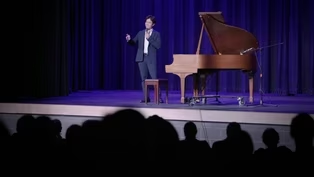
NewAward-winning pianist Jim-Isaac Chua brings classical music to rural Oregon and SW Washington
Video has Closed Captions
Clip: S27 Ep6 | 10m 6s | Award-winning pianist Jim-Isaac Chua brings classical music to rural Northwest. (10m 6s)
 New
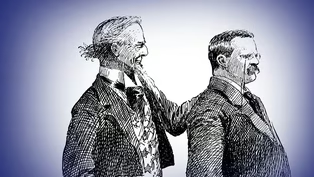
NewHomer Davenport and the Power of Political Cartoons
Video has Closed Captions
Clip: S27 Ep6 | 6m 40s | Political cartoonist Homer Davenport cut to the core of hypocrisy with a single image. (6m 40s)
Providing Support for PBS.org
Learn Moreabout PBS online sponsorship
- News and Public Affairs

Top journalists deliver compelling original analysis of the hour's headlines.













Support for PBS provided by:
Oregon Art Beat is a local public television program presented by OPB